Why Choose Rolling Tool Carts for Your Business?
Why Choose Rolling Tool Carts for Your Business?
A busy workshop rarely loses time through one dramatic failure. Small delays accumulate. A technician walks across the floor for one wrench, then returns for fasteners. Rolling Tool Carts reduce these interruptions by bringing organized tools directly to the workstation. Their value is practical, not decorative. When drawers, trays, and side panels have defined locations, employees can identify missing equipment faster and restore tools consistently.
The U.S. Bureau of Labor Statistics recorded approximately 2.6 million nonfatal workplace injuries and illnesses in private industry during 2023. The Occupational Safety and Health Administration also emphasizes safer material handling, clear work areas, and reduced ergonomic strain. A properly selected cart can support these goals by limiting unnecessary carrying and keeping heavy tools near waist height. It cannot remove every hazard. Poor loading, damaged casters, or blocked aisles can create new risks.
Real improvement requires observation. Measure walking distances, tool-search time, and workstation congestion before purchasing. Check each cart’s rated capacity, drawer extension, wheel quality, brake design, and corrosion resistance. A cart that looks impressive may fail in a humid maintenance room. That mistake is easy to make. Grand View Research and other tool-storage market analyses show continuing demand for organized, mobile storage, yet market growth does not guarantee operational value for every company. Rolling Tool Carts work best when matched to actual tasks, floor conditions, and employee habits. Their strongest benefit may be simple: fewer searches, cleaner stations, and a more repeatable daily workflow.
Business Tool Storage Needs and the Role of Rolling Carts
Why Choose Rolling Tool Carts for Your Business?
Business tool storage is not only about keeping equipment off the floor. It also affects workflow, safety, and maintenance time. A rolling tool cart places frequently used tools beside the workstation. Technicians can move drills, sockets, fasteners, and measuring devices without repeated trips across the facility. In my experience, this simple change reduces interruptions during repairs. Clear drawers also make missing tools easier to notice.
A suitable cart should match the working environment. Check its load rating, drawer depth, wheel quality, and locking system before purchase. Lockable casters help keep the cart stable during precise tasks. Full-extension drawers improve access to tools at the back. In busy workshops, steel construction usually handles daily impacts better than lightweight materials. However, heavy carts can become difficult to push across uneven floors.
Small details matter.
Tool storage should follow actual work habits, not an imagined perfect routine. One team may need shallow drawers for hand tools. Another may require deeper compartments for power equipment and spare parts. Labels, foam inserts, and simple color coding can reduce searching time. They also support consistent tool returns between shifts. Yet organization can fail when storage rules are too complicated. I have seen carefully labeled carts become cluttered again within weeks. Regular checks and honest feedback are necessary. A cart should support the team’s movement, not restrict it.
Why Choose Rolling Tool Carts for Your Business?
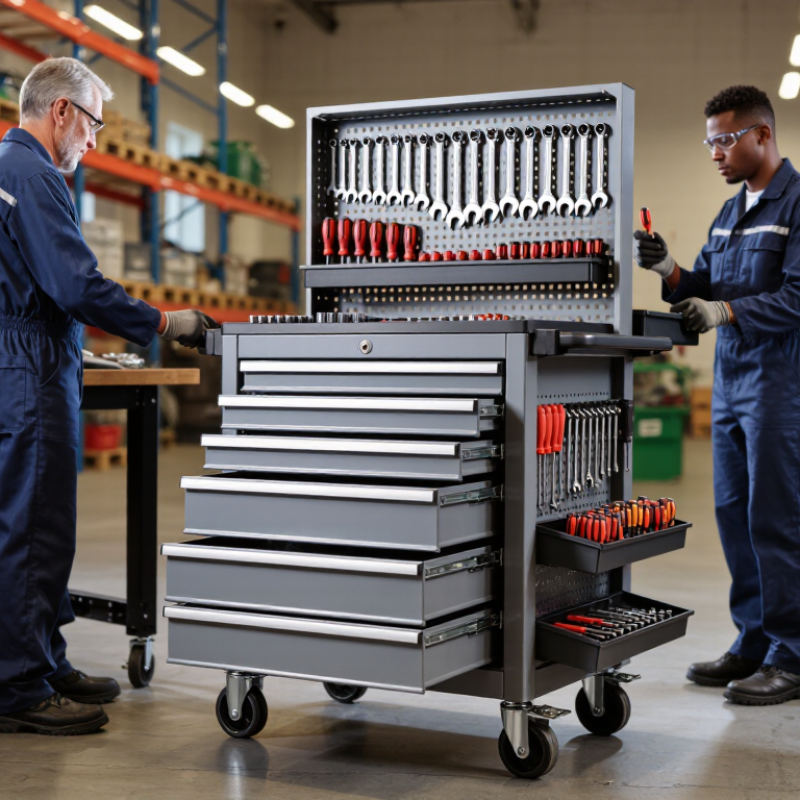
Rolling tool carts combine organized storage with workplace mobility. Typical industrial carts are designed around compact footprints, ergonomic working heights, and substantial load capacities, helping teams keep frequently used tools close to the point of work while reducing unnecessary carrying and movement.
How Mobility Improves Workplace Efficiency and Organization
Why Choose Rolling Tool Carts for Your Business?
Mobility can change how a workplace uses every minute. A rolling tool cart keeps frequently used equipment near the task. Workers avoid repeated trips across the workshop, warehouse, or service area. That saved movement can improve focus and reduce unnecessary fatigue. A cart also creates a defined home for each tool. Drawers, trays, and side panels make missing equipment easier to notice. In a busy repair room, this order matters. However, mobility is not magic. An overloaded cart may roll poorly, block walkways, or create safety concerns. Choose strong wheels, a stable frame, and brakes that hold firmly.
Tips: Group tools by task, not only by size. Place heavy items in lower drawers. Label spaces clearly. Check wheels and handles weekly. Keep aisles open, even during urgent work. A five-minute reset can prevent tomorrow’s confusion.
Good organization also supports reliable work records. When tools remain in consistent locations, staff can identify shortages faster. Shared carts help teams prepare stations with fewer delays. They can also support cleaner handovers between shifts. Still, a perfect layout rarely appears immediately. Observe how people move, then adjust drawer placement and cart positions. One overlooked detail may be the height of a handle, the turning space, or poor lighting near the storage area. Test the setup during normal work, not only during a quiet inspection.
Comparing Rolling Tool Carts with Fixed Storage Solutions
Why Choose Rolling Tool Carts for Your Business?
Comparing rolling tool carts with fixed storage solutions starts with workflow. Fixed cabinets keep tools secure, but they make every task dependent on walking back and forth. A rolling cart moves with the technician, carrying sockets, gauges, fasteners, and paperwork to the work area. In a busy maintenance shop, that small change can remove repeated trips between a bench and a machine.
The U.S. Bureau of Labor Statistics reported 946,250 days-away-from-work cases involving sprains, strains, and tears in 2022. A cart cannot prevent every injury, but it can reduce unnecessary reaching, lifting, and carrying. NIOSH ergonomic guidance also emphasizes keeping frequently used materials within easy reach. Adjustable drawers and a stable worktop support that practice better than distant fixed shelving. Keep heavy items low. It matters.
Fixed storage still has value. It offers high capacity, clear inventory zones, and strong control for rarely used equipment. However, it may create bottlenecks when several employees need the same tools. The 2023 State of Manufacturing Report from Deloitte identified operational efficiency and workforce productivity as continuing priorities for manufacturers. Mobile storage supports both, though not perfectly. Crowded aisles, poor wheel maintenance, or overloaded drawers can create new problems. In real workshops, managers should test one cart during a normal shift, measure travel time, and ask technicians what slows them down. The first layout may be wrong. That is useful evidence, not failure.
