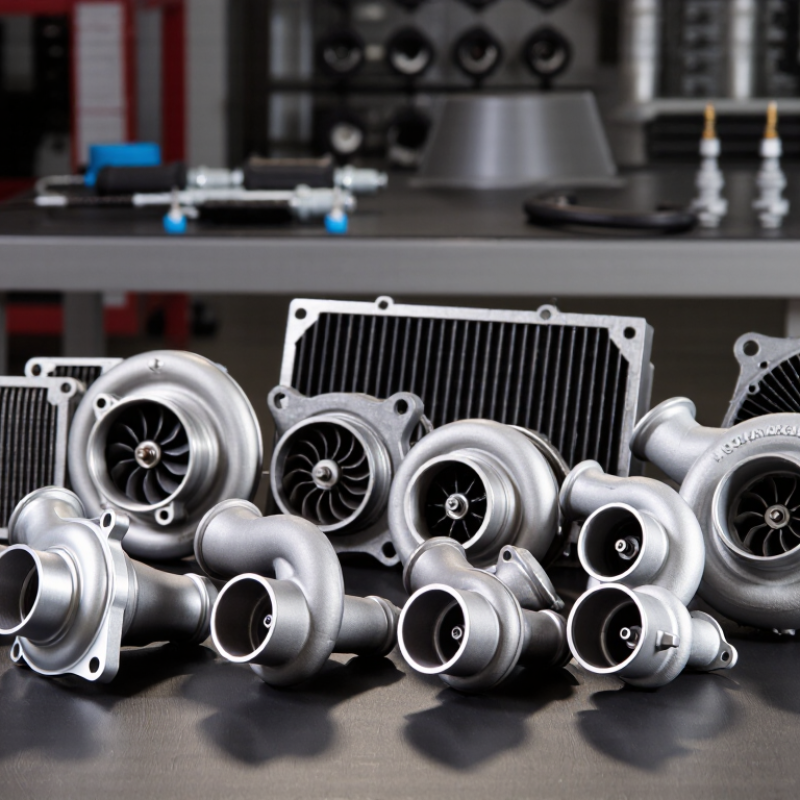
A Turbo Intercooler does more than cool compressed air. Its core, pressure drop, end tanks, and connections all affect how reliably a turbocharged engine receives that air. For global buyers, choosing a manufacturer means looking beyond a polished product photo. Ask about core construction, material specifications, pressure testing, fitment support, and production consistency. Fit matters. A small mismatch can turn installation into extra work.
Hugh MacInnes, a recognized turbocharging author and engineer, offers a useful perspective through his technical work: charge-air cooling should be considered as part of the complete turbo system. That is a paraphrase, not a direct quotation. It captures an important buying point. A large-looking intercooler is not automatically the best choice if it restricts airflow or cannot fit the vehicle. The details count.
This guide examines ten Turbo Intercooler manufacturers serving international buyers. It considers product range, manufacturing capabilities, customization, quality controls, and communication during sourcing. Buyers should verify specifications against their application and request current test or inspection records where relevant. Supplier claims deserve questions. A catalogue cannot prove long-term performance by itself. Some choices will still involve trade-offs: price, lead time, packaging, and technical support rarely align perfectly. The comparison is a starting point, not a substitute for engineering review.
A turbo intercooler cools compressed air before it reaches the engine. Cooler, denser air can support more consistent engine operation, though results depend on the full system. Air-to-air cores transfer heat to passing outside air. They are common where the front of the vehicle has clear airflow. Air-to-water designs use coolant and a separate heat exchanger, which can help in tighter layouts. Each type has trade-offs.
Core construction affects durability and heat transfer. Bar-and-plate cores often tolerate demanding use, while tube-and-fin designs can be lighter. Aluminum is widely used because it conducts heat well and keeps weight manageable. End tanks guide air into the core; poorly shaped transitions can create uneven flow. Watch the details. A wide core alone does not guarantee better cooling. Pressure drop, fin design, ducting, and installation space all matter. Measurements from a real setup are more useful than assumptions based on appearance.
Tips: Check inlet and outlet temperatures under comparable conditions, and inspect for leaks or blocked fins. Keep ducting sealed so air passes through the core, not around it. One fitting may still create a restriction, so review the whole airflow path before choosing a unit.
Top 10 Turbo Intercooler Manufacturers for Global Buyers
At a 2.0 compressor pressure ratio, air entering at 25°C can leave the compressor near 118°C if isentropic efficiency is 70%. This is an estimate, not a guaranteed vehicle reading. Using the standard compressor-efficiency definition in ASME PTC 10, and air’s approximate heat-capacity ratio of 1.4, the ideal outlet is about 90°C; inefficiency raises the actual temperature. Hotter air is less dense, so it can reduce the mass of oxygen reaching the engine. That is why intercooler performance matters beyond appearance or core size.
Real results depend on airflow, humidity, compressor speed, heat soak, and pressure losses. A useful check is to measure temperatures immediately before and after the intercooler under repeatable load, alongside pressure drop. The U.S. Department of Energy’s Improving Compressed Air System Performance sourcebook explains that intercooling can reduce compression work in multistage systems; however, that finding is not a direct prediction for a vehicle’s charge-air temperature. Small distinction, big deal. A compact core may cool well at speed but struggle in slow traffic, while an oversized core can add restriction. The 118°C estimate is a sound starting point, not the whole story.
Estimated outlet temperatures assume 25°C inlet air, 70% isentropic compressor efficiency, and a constant air heat-capacity ratio of 1.4. At a pressure ratio of 2.0, the calculated outlet temperature is about 118°C. These are thermodynamic estimates, not product test results; an intercooler reduces the compressed air temperature before it reaches the engine.
SAE J1723 offers a consistent framework for comparing charge-air-cooler performance, but only when test conditions match. Buyers should compare heat rejection and pressure drop at the same inlet temperatures, air mass flow, and ambient conditions. Otherwise, a larger heat-rejection figure may simply reflect a more demanding test. Details matter.
A practical check is the heat balance. Using the air specific heat value of about 1.005 kJ/kg·K cited in the ASHRAE Handbook—Fundamentals,
an illustrative test at 0.25 kg/s with a 60°C temperature drop rejects about 15.1 kW. This is a calculation, not a published product result.
Record pressure drop at that same flow; even a few kilopascals can change the comparison. SAE J1723 is the relevant test reference, not a universal pass mark. Ask for raw inlet and outlet temperatures, flow rate, pressure readings, and uncertainty.
Real roads are messier. A lab result cannot capture every installation, and I would treat a single headline number with caution.
Comparing the top 10 turbo intercooler manufacturers takes more than checking core size or quoted price. Design details matter: fin density, tube layout, tank shape, and weld consistency can affect airflow, heat transfer, and fitment. Ask for dimensional drawings and pressure-test information. A clear drawing can prevent a costly mismatch.
Capacity should match the intended engine output and operating conditions, not just a headline horsepower figure. Check production volume, lead times, and whether samples can be inspected before a large order. Standards and quality records also deserve scrutiny; request the applicable test methods, material specifications, and traceability documents. Requirements vary by market and application. Details matter.
Global support is practical, not decorative. Confirm response times, packaging methods, spare-part availability, and how warranty claims are handled across time zones. A supplier may offer broad export experience but limited technical support after shipment. That gap is easy to miss. Compare written evidence across all ten candidates, and leave room for an imperfect result: a specification sheet cannot reveal every issue found during installation or long-term use.
Choosing among the top turbo intercooler manufacturers starts with the vehicle’s cooling duty, not the largest catalog core. Record engine output, boost range, ambient temperatures, and expected load duration. A delivery van climbing long grades needs different heat rejection from a lightly driven car. Ask suppliers for core dimensions and pressure-drop data at specified airflow. Figures without test conditions are difficult to compare.
Tips: Measure the space between nearby components, including hose bends and service access. Check whether pressure-loss figures match your operating airflow. Fit matters. A simple cardboard template can reveal clearance problems before ordering.
Packaging, durability, and supply also shape a sound choice. Confirm mounting points, inlet and outlet positions, and material specifications against the vehicle’s actual layout. Request information about inspection, replacement parts, and typical lead times. A compact core may fit neatly but restrict airflow; a larger one may require awkward pipework. There is no universal winner. Even careful measurements can miss a bracket or heat shield, so verify fitment before production. Compare suppliers using the same requirements, and document any assumptions. That makes the decision easier to review later.
| Supplier Profile | Typical Core Construction | Indicative Cooling Duty | Pressure-Loss Consideration | Packaging Strength | Best-Fit Application | Supply and Validation Checks |
|---|---|---|---|---|---|---|
| 1. High-volume automotive specialist | Aluminum bar-and-plate or tube-and-fin cores; production-oriented joining and inspection processes | Selected to the engine’s airflow, charge temperature, and duty cycle; effectiveness must be confirmed at the specified test point | Request pressure-drop data at the intended mass flow and inlet temperature; avoid comparing figures measured at different flows | Good fit for established vehicle envelopes and repeatable production packaging | Passenger vehicles and light commercial vehicles with stable annual demand | Check production capacity, process controls, dimensional capability, traceability, and vehicle-level validation scope |
| 2. Heavy-duty and off-highway specialist | Robust aluminum or copper-brass construction, depending on heat-exchanger design and service requirements | Designed around sustained load, ambient conditions, engine airflow, and cooling-system constraints | Assess pressure loss at continuous-duty flow; confirm the result does not compromise compressor operating margin | Can accommodate larger cores, protective structures, and vehicle-specific mounting interfaces | Construction, agricultural, mining, and heavy transport equipment | Verify vibration, thermal-cycle, corrosion, and service-life test requirements for the operating environment |
| 3. Motorsport and performance fabricator | Typically aluminum bar-and-plate cores with application-specific tanks and connections | Often optimized for high airflow and short-duration or repeated high-load operation; performance depends on vehicle airflow | Compare pressure drop against cooling performance at the same flow rate; a larger core alone does not guarantee lower loss | Flexible with custom tanks, hose positions, and installation clearances | Performance road vehicles, track cars, and low-volume builds | Ask for flow-bench data, core dimensions, mounting drawings, and evidence from representative vehicle testing |
| 4. Custom-engineering and prototype supplier | Prototype or low-volume cores using established aluminum heat-exchanger constructions | Can be tailored after defining target airflow, inlet conditions, outlet-temperature limits, and available frontal area | Require a documented design point and measured pressure-drop curve rather than a single unqualified value | Strong fit for unusual shapes, tight clearances, and early-stage packaging studies | Prototypes, specialty vehicles, and low-volume programs | Confirm design ownership, prototype lead time, drawing approval process, and repeatability before production release |
| 5. Aluminum brazed-core specialist | Aluminum components joined through controlled brazing processes; core design varies by application | Thermal performance depends on fin geometry, core depth, airflow distribution, and the test conditions | Request pressure-drop and thermal-performance results together, including the airflow and charge-air flow used | Useful where compact, integrated aluminum assemblies are required | Automotive and industrial applications requiring engineered aluminum heat exchangers | Review brazing-process controls, leak testing, cleanliness requirements, and applicable material specifications |
| 6. Tube-and-fin production supplier | Tube-and-fin construction, with design options for core dimensions and fin arrangement | Selected according to heat rejection needs and available air-side conditions; suitability is application-specific | Check both charge-side and air-side restrictions, especially where the available frontal area is limited | Can suit conventional rectangular layouts and established vehicle packaging | Replacement, commercial, and industrial heat-exchanger programs | Verify dimensions, connection details, leak-test criteria, corrosion protection, and production consistency |
| 7. Bar-and-plate core supplier | Stacked aluminum plates and bars forming charge-air passages and external heat-transfer surfaces | Core depth and surface area can be selected to balance heat transfer, mass, and available space | Evaluate the pressure-drop trade-off as core depth and internal passage geometry change | Well suited to compact, durable assemblies where a strong core structure is needed | Performance, commercial-vehicle, and demanding industrial applications | Request flow and thermal test data, pressure rating, burst-test basis, and dimensional tolerances |
| 8. Integrated cooling-module supplier | Intercooler supplied as part of, or coordinated with, a broader cooling package | Considered alongside radiator, condenser, fan, and vehicle airflow requirements | Assess total system airflow and pressure losses; an isolated core test may not represent installed performance | Can simplify module-level interfaces and packaging coordination | New vehicle platforms and programs with multiple heat exchangers in a shared front-end package | Clarify interface responsibility, module testing, installation validation, and change-control procedures |
| 9. Regional aftermarket supplier | Common replacement configurations, usually based on established core and connection formats | Suitability depends on matching the application and operating conditions; published fitment does not replace performance data | Request test conditions and confirm that the intercooler meets the engine’s airflow and allowable pressure-loss needs | Often focused on common vehicle fitments and replacement availability | Service replacement and established aftermarket applications | Check fitment records, warranty terms, product identification, return process, and batch consistency |
| 10. Export-oriented contract manufacturer | Construction and materials depend on the approved drawing and manufacturing specification | Must be defined in the purchase specification; avoid relying on a generic cooling-capacity claim | Set an agreed pressure-drop test method, flow point, and acceptance limit before order placement | May support customer-designed packaging and private-label or contract production without naming a brand here | Global sourcing programs with controlled drawings and defined inspection requirements | Confirm Incoterms, packaging, export documentation, lead-time commitments, quality audits, and corrective-action capability |

If for some reason you did not find the service or product you need, you can always leave a request for a free consultation and get an answer.