
en es

Top 10 Oil Storage Tank Manufacturers Worldwide

Choosing among the Top 10 Oil Storage Tank Manufacturers Worldwide requires more than comparing prices or production capacity. A dependable Oil Storage Tank Manufacturer should demonstrate engineering experience, tested materials, disciplined fabrication, and responsive after-sales support. Buyers should examine weld quality, corrosion protection, roof design, foundation requirements, inspection records, and maintenance planning. A polished website proves very little.

Philip E. Myers, a recognized tank-engineering author, offers a useful reminder: “A storage tank is a system, not merely a vessel.” This principle remains practical today. Tank performance depends on product characteristics, climate, soil conditions, loading cycles, and operating habits. A manufacturer may build impressive tanks, yet still fail to meet a project’s real needs. That possibility deserves attention.

This introduction evaluates leading manufacturers through technical capability, manufacturing scale, quality controls, customization, delivery performance, and industry reputation. It also considers whether companies communicate clearly when problems appear. That matters in the field. A tank standing under harsh sunlight, beside salty air, or on uneven ground will reveal weaknesses quickly.

No ranking can fit every project. An economical tank may suit one facility but create higher maintenance costs elsewhere. A famous supplier may also have limits. Buyers should verify certificates, references, inspection procedures, and regional service coverage before signing contracts. The strongest manufacturers do not simply sell steel. They provide a storage solution that remains dependable through changing conditions, careful operation, and years of inspection.
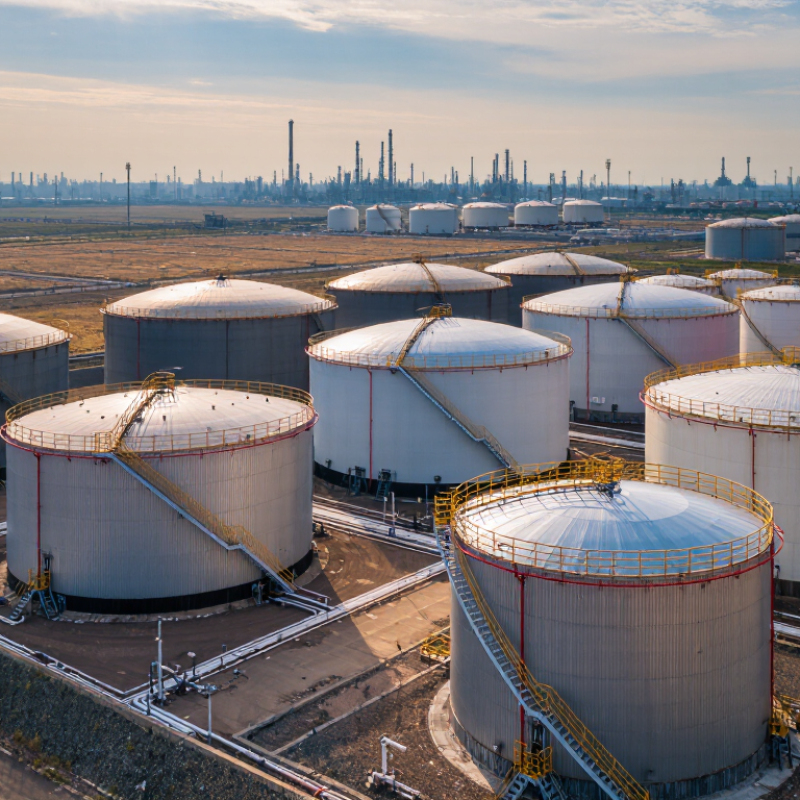
Top 10 Oil Storage Tank Manufacturers Worldwide

Global Oil Storage Tank Market: Capacity, CAGR, and 2024–2030 Demand

Global oil storage tank demand is expected to expand at a mid-single-digit CAGR from 2024 to 2030. Forecasts differ by region, tank type, and product category, so one fixed figure can mislead. Growth is linked to fuel security, refinery upgrades, petrochemical production, and expanding import terminals.

Capacity is not simply about building larger tanks. Operators need practical volume, safe separation, and reliable turnover. A coastal terminal may require several million barrels, while an inland depot may use smaller tanks for regional distribution. Floating-roof designs can reduce vapor losses, but maintenance quality remains critical. Small details matter.

The top ten global manufacturers compete through engineering depth, fabrication capacity, and compliance experience. Buyers should examine welding controls, coating systems, foundation design, inspection records, and delivery performance. Local weather also changes the specification. High winds, seismic activity, salt air, and temperature swings can shorten service life when ignored.

Demand may rise steadily, but forecasts remain imperfect. Economic slowdowns, energy transitions, trade disruptions, and changing fuel inventories can alter new-build plans. Some projects may be announced early and delayed later. That uncertainty deserves more attention than impressive capacity figures. A credible supplier explains assumptions, documents testing, and allows independent inspection before commissioning.

Ranking the Top 10 Manufacturers by Capacity, Projects, and API 650 Compliance

The Top 10 oil storage tank manufacturers should be ranked by evidence, not publicity. This analysis weights delivered storage capacity at 40%, active and completed projects at 35%, and API 650 compliance at 25%. Delivered capacity means verified tank volume, shell construction, and commissioning records. It excludes unbuilt proposals and vague annual production claims.

40%
delivered storage capacity
35%
active and completed projects
25%
API 650 compliance

Demand remains significant. The International Energy Agency’s Oil 2024 report forecasts global oil demand reaching 105.4 million barrels per day by 2030. The U.S. Energy Information Administration reported roughly 1.3 billion barrels of U.S. working crude storage capacity in 2024. These figures support capacity as a practical ranking measure, but they do not prove manufacturing quality. Project records must show tank diameter, volume, location, service conditions, and completion status. Details matter.

API 650 compliance deserves close review.

Strong manufacturers provide design calculations, welding procedures, non-destructive examination records, material traceability, and hydrostatic testing evidence. API 653 inspection requirements also matter after commissioning. However, API 650 is not a universal quality certificate. Documentation can be incomplete. Public data can be uneven. Therefore, the ranking remains partly imperfect, especially where private project owners disclose limited information. A careful buyer should verify every claim against contracts, inspection files, and independent engineering reports.

Tank Standards: API 650, API 620 Up to 15 psig, and ISO 28300

Top 10 Oil Storage Tank Manufacturers Worldwide

Tank Standards: API 650, API 620 Up to 15 psig, and ISO 28300

Selecting an oil storage tank starts with pressure, temperature, fluid properties, and site conditions. API 650 commonly supports welded tanks operating near atmospheric pressure. It guides shell design, roof construction, materials, welding, inspection, and testing. API 620 addresses larger welded tanks with low internal pressure, up to 15 psig. This difference matters when vapor pressure or operating conditions exceed conventional atmospheric service.

ISO 28300 focuses on venting for atmospheric and low-pressure storage tanks. It helps engineers evaluate normal breathing, thermal expansion, filling, emptying, and emergency conditions. A tank may satisfy API 650 yet still need careful vent sizing under ISO 28300 principles. Small calculation errors can create serious operating problems. Vent paths must remain accessible, protected, and compatible with the stored product.

Experienced manufacturers should provide traceable material certificates, qualified welding procedures, inspection records, and hydrostatic test results. Site experience also matters. Foundations, settlement, wind, seismic loads, corrosion allowance, and drainage can influence long-term reliability. I have seen specifications that looked complete but ignored local temperature swings. That gap deserves challenge. A strong supplier explains design assumptions clearly, not only the steel thickness. Buyers should compare engineering competence, quality controls, documentation, and after-sales inspection support across the leading ten manufacturers. The lowest quoted price may hide missing testing, weak corrosion planning, or unsuitable vent details.

Technology Comparison: Fixed-Roof, External-Floating, and Internal-Floating Tanks

Fixed-roof, external-floating, and internal-floating tanks serve different operating priorities. The choice affects emissions, maintenance, safety, and usable capacity. According to OPEC’s 2024 Annual Statistical Bulletin, global oil demand reached about 102 million barrels per day in 2023. Storage operators therefore need reliable systems, not simply larger tanks.

Fixed-roof tanks usually offer the lowest construction cost and simpler inspection access. They suit low-volatility products and facilities with effective vapor-control equipment. However, vapor space changes can increase breathing losses. The U.S. EPA’s AP-42 Chapter 7 estimates that floating-roof designs can reduce volatile organic compound losses substantially compared with conventional fixed roofs. Results vary with liquid properties, seals, wind exposure, and maintenance quality.

External-floating tanks place the roof directly on the liquid surface. They generally provide strong emission performance and easy visual inspection. Their exposed seals face rain, sunlight, and wind. Internal-floating tanks add a floating deck beneath a fixed roof. They protect the deck from weather, but inspection can become more demanding. That caveat matters. A 2024 International Energy Agency Oil report projects demand near 105 million barrels per day by 2029, increasing pressure on storage availability and operating discipline. In practice, the “best” design depends on vapor pressure, climate, turnover rate, and local engineering requirements. Cost comparisons can also mislead when foundation work, fire protection, seal replacement, and outage time are excluded. A careful procurement review should compare total lifecycle performance, not tank prices alone.

Top 10 Oil Storage Tank Manufacturers Worldwide — Technology Comparison: Fixed-Roof, External-Floating, and Internal-Floating Tanks
Rank Manufacturer Profile Primary Tank Technology Typical Service Common Capacity Range Applicable Design Standard Typical Roof Configuration Emission-Control Approach Typical Shell Material Key Engineering Strength
1 Global Profile A External-Floating Roof Crude oil, gasoline blendstocks, naphtha and other volatile petroleum liquids 20,000–160,000 m³ API 650; local fire, seismic and environmental regulations Open-top welded steel tank with pontoon or double-deck floating roof Primary rim seals, secondary seals and optional geodesic roof covers Carbon steel; stainless or corrosion-resistant components where required Large-diameter fabrication, floating-roof stability and seal design
2 Global Profile B Internal-Floating Roof Gasoline, jet fuel, diesel and other products requiring reduced vapor losses 5,000–100,000 m³ API 650; API 2000 venting guidance; applicable air-quality rules Fixed cone or self-supporting dome roof with aluminum or steel internal deck Internal rim seals, deck fittings and controlled vapor-space venting Carbon steel shell with aluminum or carbon-steel floating deck Vapor-loss reduction and integration of fixed-roof ventilation systems
3 Global Profile C Fixed-Roof Diesel, fuel oil, lubricating oil, asphalt and low-volatility liquids 500–75,000 m³ API 650; API 620 for low-pressure applications where applicable Self-supporting cone, supported cone or dome roof Pressure-vacuum vents, conservation vents and vapor recovery where required Welded carbon steel with internal coating or lining when specified Cost-effective design, reliable structural support and broad service flexibility
4 Global Profile D External-Floating Roof Large-scale crude oil terminals and petroleum export or import facilities 50,000–250,000 m³ API 650; API 653 inspection and maintenance practices Double-deck or pontoon roof with rolling ladder and perimeter seal system Primary and secondary seals, roof drains and storm-water management Welded carbon steel with corrosion allowance and selected coated areas High-volume terminal construction and site-specific wind or seismic design
5 Global Profile E Internal-Floating Roof Clean petroleum products stored near populated or environmentally sensitive areas 2,000–60,000 m³ API 650; API 2000; regional volatile-organic-compound requirements Fixed cone or dome roof with full-contact or pontoon internal floating deck Low-leakage seals, closed vent systems and vapor recovery interfaces Carbon steel shell; aluminum deck is common for reduced dead load Low-emission configuration and detailed roof-fittings optimization
6 Global Profile F Fixed-Roof Heavy fuel oil, bitumen, process oils and heated petroleum products 1,000–50,000 m³ API 650; API 2000; project-specific thermal design requirements Fixed cone or dome roof with heating coils or external heating systems Conservation venting, insulation and controlled vapor-space management Carbon steel with internal coatings selected for temperature and product service Thermal management, insulation and safe handling of high-viscosity products
7 Global Profile G External-Floating Roof Crude oil, condensate and volatile feedstocks in coastal tank farms 15,000–120,000 m³ API 650; API 653; applicable marine-terminal and fire-protection codes Single-deck pontoon or double-deck floating roof Rim seals, flexible roof drains, wind girders and optional cover roofs Carbon steel with enhanced coating systems for marine environments Corrosion protection, roof drainage and operation in high-wind locations
8 Global Profile H Internal-Floating Roof Aviation turbine fuel, gasoline and specialty hydrocarbon products 1,000–40,000 m³ API 650; applicable aviation-fuel quality and safety requirements Fixed roof with aluminum pontoon or full-contact internal floating deck Sealed deck fittings, vapor control and contamination-reduction features Carbon steel shell with aluminum or coated steel internal components Product cleanliness, inspection access and controlled vapor emissions
9 Global Profile I Fixed-Roof Water-mixed petroleum products, additives and lower-volatility liquids 300–25,000 m³ API 650; API 653 for in-service inspection and repair Fixed cone, dome or umbrella roof depending on diameter and loading Atmospheric or pressure-vacuum venting with flame-arresting equipment where required Carbon steel, stainless steel or internally lined steel according to service Adaptable fabrication for moderate capacities and diverse product chemistry
10 Global Profile J External-Floating Roof High-throughput crude oil storage connected to pipelines and refineries 25,000–180,000 m³ API 650; API 653; project-specific seismic and foundation standards Double-deck floating roof with primary and secondary rim seals Low-leakage seals, roof drains and vapor-management provisions Welded carbon steel with site-specific corrosion allowance Foundation engineering, large-scale erection and lifecycle maintenance planning
Note: The manufacturer identifiers are intentionally anonymized. Capacity ranges and technology descriptions represent commonly specified industry configurations rather than individual company claims. Final selection depends on product volatility, flash point, vapor-pressure requirements, climate, seismic conditions, emissions regulations and applicable local codes.

Safety Benchmarks: NFPA 30, Secondary Containment, and Emission Control

Top 10 Oil Storage Tank Manufacturers Worldwide

Safety performance should guide every oil storage tank selection. NFPA 30 provides a respected benchmark for flammable and combustible liquid storage. It addresses tank spacing, ignition sources, fire protection, and spill control. However, NFPA 30 is not a universal permit. Local codes still require careful review.

Secondary containment needs practical engineering. Bund walls, double-bottom tanks, and lined concrete areas can limit soil and water contamination. The design should consider tank volume, rainfall, drainage, and emergency access. A blocked drain can turn a controlled spill into a larger incident. That detail is easy to overlook. Regular inspections should check cracks, corrosion, valves, and hidden low points.

Emission control also affects tank safety and operating quality. Floating roofs, effective seals, pressure-vacuum vents, and vapor recovery systems can reduce volatile releases. Operators should monitor vapor pressure, roof movement, and seal condition during routine rounds. Sensors help, but they do not replace trained inspection. A checklist may miss a damaged gasket. Experienced teams should question unusual odors, pressure changes, and staining around connections. Manufacturers that support documented testing, clear maintenance access, and traceable materials offer stronger evidence of reliability. Some projects still prioritize price too heavily, and that choice deserves reconsideration.

Get a quote
Open chat
1
Hi! How can we help you?
Chat with Pelican Containers