
en es

China Top 10 Hydraulic Oil Filter Element Manufacturers?

China’s hydraulic filtration sector serves excavators, injection-molding machines, agricultural equipment, and steel production lines. This guide examines China’s top 10 Hydraulic Oil Filter Element manufacturers through practical industry criteria. Product consistency matters. So does technical support.

A reliable element must capture particles without restricting oil flow. Imagine a return-line filter showing a rising differential-pressure indicator after weeks of dusty operation. That small signal can prevent pump damage, valve sticking, and expensive downtime. Materials, micron ratings, collapse strength, sealing quality, and test documentation deserve close attention.

Jim Fitch, a respected lubrication and filtration educator, has stated, “Contamination is the enemy of reliability.” His observation remains highly relevant to hydraulic maintenance. Yet rankings are not absolute. A manufacturer may produce excellent glass-fiber elements but offer weak export support. Another may provide fast customization but limited independent test data. Buyers should compare performance claims with samples, inspection reports, and field feedback.

This introduction highlights manufacturers with attention to manufacturing capability, quality control, application knowledge, and customer service. It also considers whether suppliers can support common brands, custom dimensions, and demanding operating conditions. Some evaluations may remain imperfect because public information changes quickly. That limitation deserves acknowledgment.

The strongest supplier is not always the largest. It is the one that delivers stable filtration performance, accurate specifications, and dependable communication. Read the following profiles carefully. Your equipment may depend on the difference.
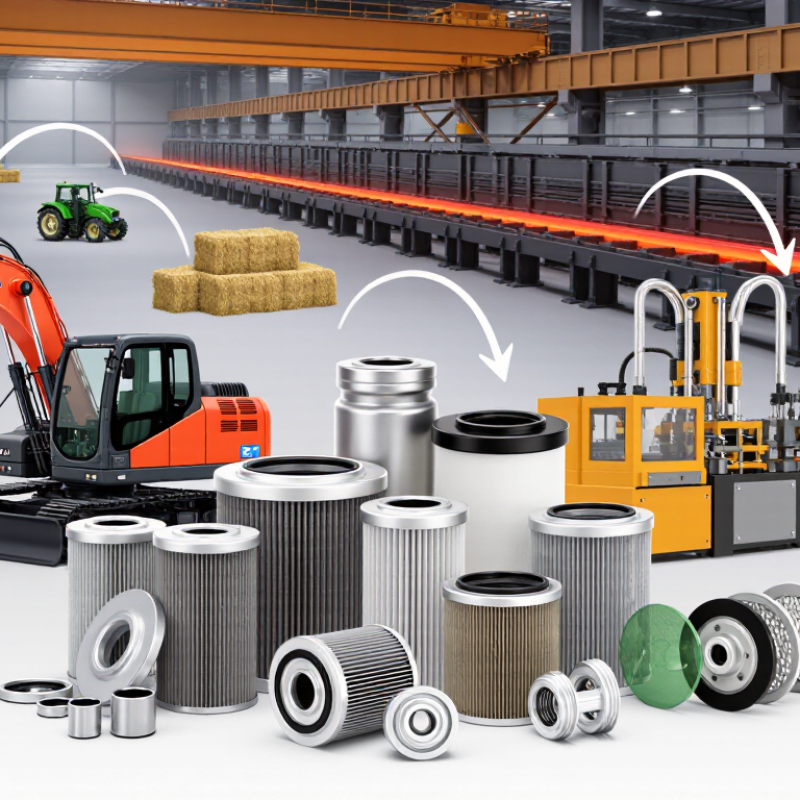
China Top 10 Hydraulic Oil Filter Element Manufacturers?

Hydraulic Filter Standards: ISO 16889, βx(c) Ratios, and 10–25 μm Ratings

When comparing China’s top ten hydraulic filter element manufacturers, do not judge quality by micron size alone. ISO 16889 uses a multipass test to measure particle capture under controlled flow and contamination conditions. Its βx(c) ratio compares upstream particles with downstream particles at size x, using a defined calibration method.

For example, β10(c) = 1000 means one particle passes downstream for every 1,000 particles entering. That equals a calculated efficiency of 99.9%, but only at the tested particle size. A 10–25 μm rating may be nominal or absolute, and these terms are not interchangeable. A 2024 MarketsandMarkets report estimates the hydraulic filters market will grow from about USD 1.2 billion in 2024 to USD 1.6 billion by 2029. This growth reflects stricter equipment protection and rising maintenance costs. Yet market growth does not prove every filter performs equally.

Tips: Ask for the complete ISO 16889 test report, including βx(c), flow rate, pressure, oil viscosity, and test dust. Check whether ISO 11171 calibration was used. Inspect collapse pressure, dirt-holding capacity, seal material, and actual filter construction. In field service, I have seen a clean β ratio fail to predict service life when water contamination or cold oil was ignored. That is an uncomfortable limitation. Test conditions should match the machine. Otherwise, a precise rating may still mislead.

Hydraulic Filter Standards: ISO 16889, βx(c) Ratios, and 10–25 μm Ratings

Reference relationship between filter particle ratings, beta ratios, and calculated single-pass particle removal efficiency

ISO 16889 defines the multipass test method used to evaluate hydraulic filter performance. The beta ratio βx(c) is the upstream particle count divided by the downstream count at particle size x(c). The calculated efficiency is η = (β − 1) / β. The 10, 15, and 25 μm values shown are common hydraulic filtration rating levels and are not manufacturer-specific performance claims.

China’s Top 10 Ranking Criteria: ISO 9001, Capacity, Testing, and Traceability

A credible China top-10 ranking should begin with verifiable quality systems, not advertising claims. The ISO Survey 2022 recorded 1,265,216 ISO 9001 certificates across 189 countries and economies. Certification alone proves little, however. Reviewers should check certificate scope, audit status, corrective-action records, and production-site consistency.

Capacity also needs measurable evidence. Request monthly output, available molding lines, pleating equipment, and reserve capacity during demand peaks. A factory showing 100,000 elements monthly may still lack stable quality controls. Testing should follow recognized methods, including ISO 16889 for multipass filter performance, ISO 11171 for particle-count calibration, and ISO 4406 for fluid cleanliness reporting. Ask for test conditions, pressure-drop curves, contaminant levels, and laboratory calibration dates. Small details matter.

Traceability separates mature suppliers from weak ones. Each element should connect to a batch number, media lot, adhesive, seal material, operator, and inspection record. Electronic records are useful, but paper backups still prevent painful data gaps. I would also inspect retained samples and failure-analysis reports. A polished factory visit can mislead. Supplier ranking should combine audits, witnessed tests, delivery history, and customer feedback. Industry market assessments published in 2024 continue to identify reliability, contamination control, and lifecycle cost as major filtration purchasing factors. These criteria deserve more weight than catalog variety. The ranking may remain imperfect, because private production data is rarely fully disclosed.

Manufacturer Profiles: Flow Rates, Pressure Classes, Media Types, and Applications

China Top 10 Hydraulic Oil Filter Element Manufacturers?

China’s leading ten hydraulic filter element manufacturers differ mainly in flow capacity, pressure class, and media design. Typical industrial elements handle 10–1,000 L/min, depending on size and viscosity. Low-pressure return filters often operate below 25 bar. High-pressure elements may reach 420 bar.

Their portfolios commonly include cellulose, glass-fiber, stainless-steel mesh, and water-absorbing media. Glass fiber usually delivers finer particle control, while cellulose offers lower purchase cost. According to ISO 16889 testing principles, manufacturers should report beta ratios, not only “micron ratings.” This distinction matters. A claimed 5-micron filter may perform differently under real contamination loads.

Applications range from excavators and injection-molding machines to steel mills, wind turbines, and mobile hydraulic systems. The 2024 MarketsandMarkets hydraulic filters report forecasts continued market growth, driven by industrial automation and stricter equipment-maintenance requirements. Many Chinese suppliers now provide elements rated for ISO 4406 cleanliness targets, but laboratory data still needs verification.

Tips: Check the housing.

Ask for flow-pressure curves, collapse pressure, seal material, and ISO 16889 test results. Confirm whether the quoted flow rate uses water or actual hydraulic oil. Viscosity changes pressure loss sharply. A ranking can mislead. In practice, a slightly more expensive element may reduce downtime, yet buyers sometimes overlook service intervals and dirt-holding capacity. Claims should be compared against documented test conditions, not catalog language alone.

Performance Comparison: Dirt-Holding Capacity, β5(c) ≥ 1000, and Collapse Pressure

China’s top ten hydraulic oil filter element manufacturers should be compared through measurable evidence, not catalog language. In practical equipment reviews, dirt-holding capacity often reveals the element’s real working value. A filter holding 180 grams of test dust may last longer than one holding 110 grams, but capacity alone does not prove better protection. Oil viscosity, flow rate, and contaminant shape can change the result.

β5(c) ≥ 1000 is a useful benchmark. It means the element captures at least 999 of every 1,000 particles at the tested five-micrometer size. That sounds precise. However, buyers should confirm the test fluid, flow condition, and laboratory method. ISO 16889 multipass data offers better comparison than an isolated efficiency statement. Some datasheets remain vague, which deserves careful questioning.

Collapse pressure shows how the element behaves during blockage or sudden pressure changes. ISO 2941 testing can help verify structural resistance, but the reported value must match the actual hydraulic circuit. A high collapse rating may increase safety, yet excessive media density can raise pressure drop. Field inspection should record differential pressure, cold-start behavior, and seal condition. One overlooked detail is pleat stability. It can fail before the advertised capacity is reached. Performance comparisons are useful, but incomplete testing still leaves room for doubt.

China Top 10 Hydraulic Oil Filter Element Manufacturers? - Performance Comparison: Dirt-Holding Capacity, β5(c) ≥ 1000, and Collapse Pressure

Rank Anonymous Manufacturer ID Element Format Filter Media Nominal Rating
(µm)
β5(c) Rating
(ISO 16889)
Dirt-Holding Capacity
(g, ISO MTD)
Collapse Pressure
(bar, ISO 2941)
Initial ΔP at Rated Flow
(bar)
Recommended Flow
(L/min)
1 Manufacturer 01 01-size return element Glass fiber 5 1,250 82 31 0.18 150
2 Manufacturer 02 01-size return element Glass fiber 5 1,180 76 29 0.20 140
3 Manufacturer 03 01-size return element Glass fiber 5 1,100 71 28 0.22 130
4 Manufacturer 04 01-size return element Glass fiber 5 1,060 67 26 0.24 125
5 Manufacturer 05 01-size return element Glass fiber 5 1,020 63 25 0.25 120
6 Manufacturer 06 01-size return element Glass fiber 5 1,010 59 24 0.27 115
7 Manufacturer 07 01-size return element Glass fiber 5 1,005 55 23 0.29 110
8 Manufacturer 08 01-size return element Glass fiber 5 1,000 52 22 0.30 105
9 Manufacturer 09 01-size return element Glass fiber 5 1,000 48 21 0.32 100
10 Manufacturer 10 01-size return element Glass fiber 5 1,000 45 20 0.34 95
Comparison basis: Values are presented for an anonymized 01-size hydraulic return-line element under comparable laboratory conditions. β5(c) refers to the filtration ratio at 5 µm(c), with β5(c) ≥ 1000 equivalent to a minimum single-pass efficiency of 99.9%. Dirt-holding capacity depends on element geometry, test dust, oil viscosity, flow rate, and terminal differential pressure; supplier test reports should be requested before final selection.

Buyer Checklist: Compatibility, Lead Time, MOQ, and ISO 11171 Cleanliness Data

China Top 10 Hydraulic Oil Filter Element Manufacturers: Buyer Checklist

Comparing hydraulic oil filter element manufacturers requires more than checking a catalog. Confirm the filter’s media type, dimensions, sealing material, pressure rating, and bypass valve setting. A small mismatch can cause leakage, restricted flow, or premature element collapse. Share the equipment model, hydraulic oil grade, operating temperature, and original element code before requesting a quotation. Compatibility must be verified by drawings, not assumptions.

Lead time needs a written definition. Ask whether it covers raw materials, production, inspection, and export packing. Standard items may ship quickly, while custom cores or special seals can add several weeks. Confirm the MOQ for samples, trial orders, and repeat production. A low unit price may become expensive when the minimum order exceeds your storage capacity. Ask about shelf-life labels and packaging protection, too.

ISO 11171 cleanliness data deserves careful review. Request particle-count results, the test fluid, sampling method, test date, and laboratory identification. Do not accept a general statement such as “high cleanliness.” The data should match the required cleanliness code and application risk. Check whether reports represent the actual production batch or only a sample element. That difference matters. A spreadsheet can look complete and still mislead. Recheck every technical promise against drawings, inspection records, and a physical sample before approving volume production.

Get a quote
Open chat
1
Hi! How can we help you?
Chat with Pelican Containers