
An Embedded Chip is the quiet decision-maker inside many everyday products. It may sit beneath a car’s dashboard, inside a medical monitor, or behind a smart lock’s plastic casing. Unlike a general-purpose computer, it performs focused tasks within a larger device. W. Wayne Wolf, author of Computers as Components, explains, “An embedded computer is a computer that is part of a larger system.” That simple definition remains useful, although modern devices make the boundaries less clear.
Inside, a processor executes firmware stored in memory. Sensors provide data, while input-output interfaces control motors, displays, alarms, or wireless links. The chip repeatedly follows a control loop: measure, decide, and respond. In a vehicle, this can mean reading wheel speed and adjusting braking within milliseconds. Timing matters. Small delays can become serious engineering problems.
Market data shows why this technology deserves closer attention. MarketsandMarkets projects the embedded systems market to grow from about $116.2 billion in 2024 to $159.6 billion by 2029. Grand View Research also forecasts sustained growth, driven by automotive electronics, industrial automation, healthcare, and connected devices. These reports use different definitions, so their figures should not be treated as identical facts. That limitation matters.
The real story is not only market size. It is dependable behavior under heat, vibration, limited power, and imperfect network connections. This guide examines what an Embedded Chip contains, how it works, and why its design choices affect safety, performance, and product life. The explanation will remain practical, because datasheets alone rarely show the whole picture.
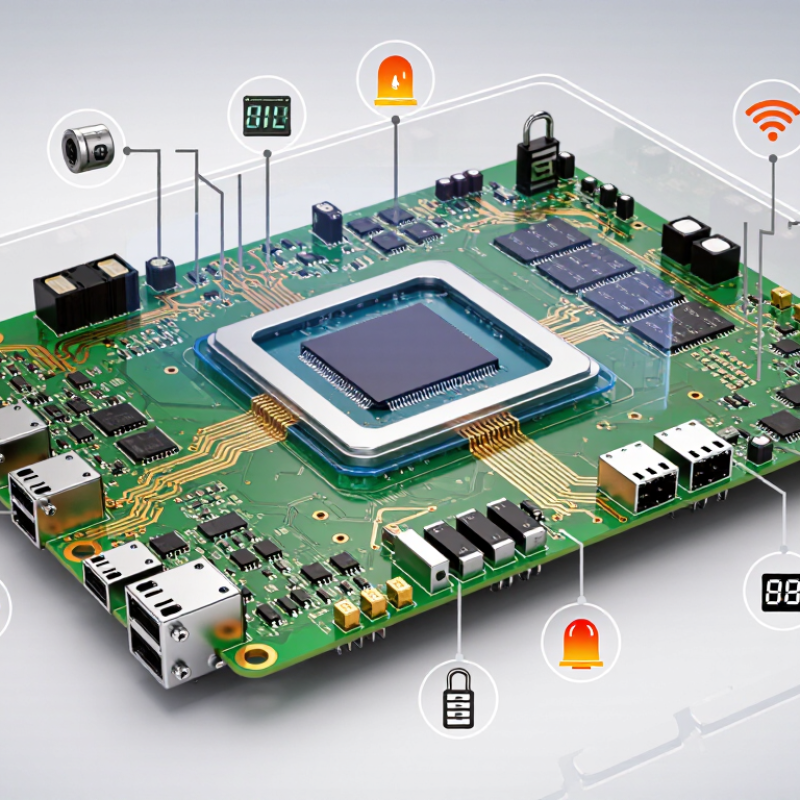
An embedded chip is a compact integrated circuit built into a larger product. It performs a defined task, rather than acting as a general-purpose computer. A typical microcontroller combines a processor core, memory, timers, and input-output circuits. In a thermostat, it samples a temperature sensor, runs a control rule, and sends a signal to a relay. That loop may repeat thousands of times per second. Small, but not simple. The term is not perfectly fixed. Some engineers include application-specific processors and power-management circuits. Others reserve it for programmable controllers. That boundary deserves more care.
At startup, firmware tells the chip how to initialize memory, read sensors, and control outputs. An analog-to-digital converter changes a voltage into numerical data. The processor then compares that data with programmed conditions. Timers coordinate events, while nonvolatile memory stores settings after power is removed. The 2024 State of IoT report counted 16.6 billion connected devices in 2023. It projected 18.8 billion for 2024. Many of those devices depend on embedded chips for local decisions.
The WSTS Autumn 2024 forecast projected worldwide semiconductor sales of about 687 billion dollars in 2025. That figure reflects a broad market, not embedded chips alone. Still, it shows the scale supporting these small controllers. In practice, engineers must balance speed, energy use, heat, cost, and software reliability. A faster chip is not always better. A missed sensor reading can matter more than extra processing power. The definition sounds clear, but real designs remain messier.
An embedded chip is a compact computing system built for a dedicated task. Its core usually starts with a CPU or microcontroller core. This unit executes instructions, reads sensor values, and controls outputs. Flash memory stores firmware, while RAM holds temporary data during operation. Many chips also include timers, analog-to-digital converters, and pulse-width modulation circuits. These blocks let a thermostat measure temperature and switch a heater without a separate computer.
Power management is equally important. Voltage regulators and sleep modes reduce energy use between tasks. Communication interfaces, such as serial buses and wireless controllers, move data between the chip and other devices. Security hardware can protect keys and verify firmware before startup. The 2024 State of IoT report estimated 18.8 billion connected IoT devices worldwide. That growth increases demand for smaller, lower-power processing platforms. Still, “all-in-one” does not mean flawless. Limited memory can create slow responses, and poor thermal design may shorten service life.
Tips: Match memory size to real workloads, not optimistic estimates. Test startup time, heat, and sleep current on physical hardware. Leave spare input pins where possible. Field changes happen. A useful design review also checks failure behavior, because a disconnected sensor should trigger a safe response, not silent damage.
| Component or Feature | Primary Function | How It Works | Typical Characteristics | Role in an Embedded System |
|---|---|---|---|---|
| Central Processing Unit | Executes program instructions | Fetches, decodes, and processes instructions using arithmetic, logic, and control operations. | Usually includes one or more processing cores; performance depends on clock frequency, architecture, and instruction efficiency. | Acts as the main decision-making unit that controls system behavior. |
| Program Memory | Stores firmware and constant data | Retains instructions so the processor can start and run the embedded application after power is applied. | Common technologies include flash memory, read-only memory, and electrically erasable nonvolatile memory. | Holds the operating logic, control algorithms, and startup code. |
| Data Memory | Stores temporary variables and runtime information | Provides fast read and write access while the processor is executing instructions. | Static random-access memory is commonly used for temporary data because it is fast and does not require refresh cycles. | Supports calculations, buffers, task management, and temporary state information. |
| Nonvolatile Data Storage | Preserves settings and data without power | Stores calibration values, configuration parameters, event logs, or user preferences after the system is turned off. | Typically offers lower write endurance than volatile memory and may require special write-management techniques. | Maintains important information across power cycles. |
| Clock and Timing Circuitry | Provides synchronized timing signals | Generates or distributes clock pulses that coordinate processor operations and peripheral activity. | May use an internal oscillator, an external crystal, or a phase-locked loop for frequency control. | Determines operating speed and keeps digital operations synchronized. |
| General-Purpose Input/Output | Connects the chip to external digital signals | Configurable pins read logic levels from sensors or switches and drive external actuators, indicators, or control circuits. | Pins may support input, output, pull-up, pull-down, interrupt, or alternate peripheral functions. | Provides flexible digital interaction with the surrounding hardware. |
| Analog-to-Digital Converter | Converts analog signals into digital values | Samples an input voltage and represents its amplitude as a numerical code for processing by the CPU. | Important specifications include resolution, sampling rate, input range, and conversion accuracy. | Allows the chip to measure physical quantities such as temperature, pressure, light, and voltage. |
| Digital-to-Analog Converter | Generates analog output signals | Transforms digital codes into proportional voltages or currents for external circuits. | Performance is described by resolution, update rate, output range, and linearity. | Supports audio generation, analog control, waveform output, and calibration functions. |
| Timers and Counters | Measure time and generate scheduled events | Count clock pulses to create delays, measure signal periods, or produce periodic interrupts. | Often support input capture, output compare, pulse-width modulation, and event counting. | Controls precise timing, motor speed, signal generation, and periodic tasks. |
| Interrupt Controller | Responds quickly to important events | Pauses normal program execution and directs the processor to a specific service routine when an interrupt occurs. | Can manage external interrupts, timer events, communication events, and internal fault conditions. | Improves responsiveness without requiring the CPU to continuously poll every event. |
| Communication Interfaces | Exchange data with other devices | Use defined electrical and communication protocols to transmit and receive digital information. | Common interfaces include serial peripheral interface, inter-integrated circuit, universal asynchronous receiver-transmitter, controller area network, and universal serial bus. | Connects the embedded chip to sensors, memory devices, displays, controllers, and networks. |
| Pulse-Width Modulation Unit | Controls average power or analog-like output | Adjusts the duty cycle of a digital pulse train to regulate delivered energy or represent a control value. | Key parameters include frequency, duty-cycle resolution, output channels, and synchronization options. | Controls motors, LED brightness, heaters, power converters, and servos. |
| Power Management Circuitry | Regulates and distributes internal power | Converts and controls supply voltage for different internal circuit domains and operating modes. | May include voltage regulators, brownout detection, sleep modes, and power-on reset functions. | Improves reliability, energy efficiency, and safe startup behavior. |
| Reset and Watchdog Timer | Recovers the system from abnormal conditions | Resets the chip when power is unstable, startup conditions are invalid, or software fails to periodically respond. | Watchdog intervals are configurable; reset sources can include external pins, voltage faults, and software commands. | Helps maintain autonomous operation in unattended equipment. |
| Debug and Test Circuitry | Supports software development and hardware diagnosis | Provides controlled access for programming, tracing, breakpoints, register inspection, and production testing. | May use dedicated debug pins or shared communication pins, depending on the chip design. | Reduces development time and helps identify faults during manufacturing and maintenance. |
| Operating Temperature Range | Defines acceptable environmental conditions | Specifies the temperature limits within which electrical performance and reliability are guaranteed. | Ranges vary by device category and application; wider ranges generally support more demanding environments. | Determines whether the chip is suitable for consumer, industrial, automotive, or specialized equipment. |
| Power Consumption | Determines energy usage and heat generation | Depends on clock activity, supply voltage, circuit load, memory access, and active or sleep mode. | Often specified as active, standby, sleep, and leakage current or power values. | Influences battery life, thermal design, enclosure size, and system operating cost. |
An embedded chip combines processing, memory, input/output, timing, communication, and power-control functions in a compact integrated circuit designed for a dedicated application.
An embedded chip is a compact computing unit built into a larger device. It may control a sensor, motor, display, or safety function. When a sensor detects temperature, pressure, or movement, it produces an electrical signal. The chip receives that signal through an input circuit. An analog-to-digital converter then changes it into numerical data. The processor compares those values with programmed instructions.
Not magic.
Inside the chip, information moves through registers, memory, and processing circuits. A register holds a small value for immediate use. Memory stores settings, measured data, and instructions. The control unit tells each circuit when to read, calculate, or respond.
If the measured value exceeds a limit, the chip can activate an output. That output might adjust a valve, change a display, or send a warning. Timing matters. A delayed response can reduce performance, especially in medical, automotive, or industrial equipment.
Reliable processing depends on both hardware and software. Engineers test chips with normal signals, sudden changes, and unexpected readings. Bench testing often exposes problems that simulations miss. Heat, electrical noise, and limited memory can affect results. Poorly written instructions may also create incorrect decisions. A careful design adds error checks and recovery routines. Still, no system is perfect. A sensor can be inaccurate, and a chip can only process the information it receives. That limitation deserves more attention.
An embedded chip is a small computing component built into a larger product. It reads sensor signals, processes instructions, and controls an action. Unlike a general-purpose computer, it usually performs a dedicated task. In real use, it may monitor motor temperature, adjust braking pressure, or keep a thermostat within one degree. The boundary is not always perfectly clear.
Embedded chips appear across homes, vehicles, factories, medical equipment, and public infrastructure. IoT Analytics reported 16.6 billion connected IoT devices worldwide in 2023, with approximately 18.8 billion expected in 2024. Many of these devices depend on embedded processors, memory, and communication circuits. The International Energy Agency recorded almost 14 million electric car sales in 2023. Each vehicle can contain numerous controllers for battery management, charging, safety, and cabin systems. Industrial use is also substantial. The International Federation of Robotics reported more than 541,000 industrial robot installations in 2023. These machines rely on chips for motion accuracy and real-time feedback.
Tips: Match the chip to the environment. Check heat, vibration, power limits, update support, and failure behavior. A cheap component may increase maintenance costs. Designers sometimes focus too heavily on processing speed. Reliability often matters more. A practical test should include dusty workshops, cold starts, and unstable signals. Safety decisions should remain independently verified.
What Is an Embedded Chip and How Does It Work?
An embedded chip is a small computing device built into a larger product. It may read sensors, process signals, and control physical actions. Inside, a processor follows programmed instructions stored in memory. For example, a chip in a thermostat measures room temperature and activates heating equipment. Its compact design allows intelligent control without a separate computer.
Embedded chips offer speed, low power use, and consistent performance. They can respond within milliseconds, which matters in safety equipment and industrial machines. Their fixed purpose can also simplify product design and reduce operating costs. However, these chips have limitations. Limited memory restricts complex software and future upgrades. Heat, moisture, electrical noise, and poor firmware can cause failures. Replacing the chip may require specialized tools. A design that seems efficient today can become difficult to maintain later. That assumption can fail.
Tips: Define the chip’s task before selecting hardware. Check memory, processing speed, temperature range, and power requirements. Test the complete product under realistic conditions, not only in a quiet laboratory. Keep firmware documentation clear and versioned. Security also deserves attention, even in simple devices. Avoid unnecessary features. They consume resources and create more possible faults. Engineers should review failure records regularly, because small repeated errors often reveal deeper design weaknesses.
An embedded chip is an integrated circuit designed to perform a dedicated function inside a larger product. It typically combines a processor, memory, input/output interfaces, and control logic to collect data, execute firmware, and control hardware in real time.
The chart shows representative industry ranges rather than fixed specifications. Higher clock frequency can support more complex processing, while lower-frequency microcontrollers are often preferred for simplicity and energy efficiency.
If for some reason you did not find the service or product you need, you can always leave a request for a free consultation and get an answer.