
en es

China Top Air Pollution Detection Drone Suppliers

Air pollution rarely stays within the neat boundaries shown on a map. Wind shifts, street canyons, and industrial plumes create sharp local differences. Air Pollution Detection Drones can sample these changing conditions above roads, rooftops, and hard-to-reach sites. They help teams see where ground monitors leave gaps.

The World Health Organization reports that 99% of the global population breathes air exceeding its guideline limits. The State of Global Air 2024 report estimates that air pollution contributed to 8.1 million deaths worldwide in 2021. These figures make reliable measurement more than a technical detail. The gaps matter. WHO Director-General Dr. Tedros Adhanom Ghebreyesus has said, “Air pollution is a threat to health in all countries, but it hits people in low- and middle-income countries the hardest.” His warning underscores the value of better local evidence, though drones alone cannot solve exposure problems.

This guide to China’s top air pollution detection drone suppliers focuses on practical capabilities: sensor options, flight endurance, calibration support, data processing, and after-sales service. A useful platform should measure pollutants consistently and document how its readings are checked against reference instruments. Buyers should also ask how wind, humidity, and payload weight affect results. Not a magic fix. A drone is not a substitute for a calibrated monitoring network, and that distinction is easy to overlook. Still, carefully deployed systems can add useful detail to air-quality surveys.
China Top Air Pollution Detection Drone Suppliers

Air Pollution Detection Drones: Roles and Capabilities in China

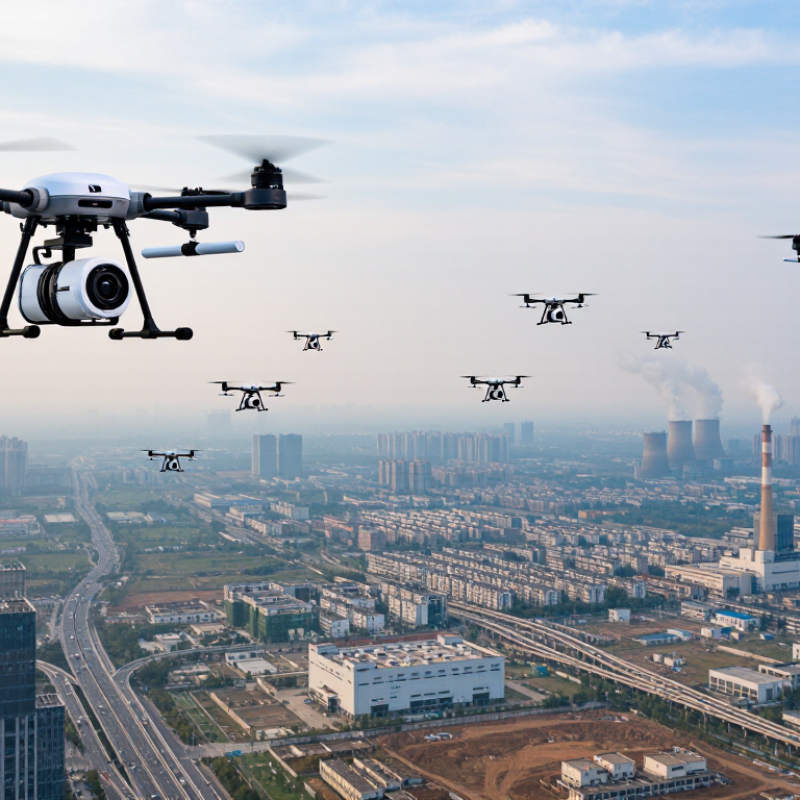
In China, air-pollution detection drones serve as mobile screening tools, extending the reach of fixed monitoring stations. They can sample air at different heights, trace pollution gradients across roads or industrial areas, and revisit locations where readings suddenly rise. A typical payload may measure particulate matter and selected gases, alongside temperature, humidity, and wind. Useful, not magic.

The Ministry of Ecology and Environment’s 2023 China Ecological Environment Status Bulletin reported an average PM2.5 concentration of 30 micrograms per cubic metre across 339 prefecture-level cities. That broad figure provides context, but it cannot describe every street or hour. Drone flights can help investigate local variation, especially when teams compare readings with nearby ground sensors and weather data. The World Meteorological Organization’s guidance on air-quality measurement also underscores the importance of calibration and quality control.

Sensor readings can shift with humidity, vibration, airflow, and sampling height. A colorful flight map may look precise while hiding drift or sparse measurements. Operators should document routes, sensor checks, and weather conditions, then treat drone results as complementary evidence—not automatic substitutes for regulatory-grade stations. Some uncertainty remains; that should be stated, not smoothed away.

Key Sensors and Monitoring Technologies Used by Chinese Suppliers

Air-quality drones are only as useful as their sensors and sampling setup. Chinese suppliers commonly combine optical particle counters with gas sensors and onboard positioning. Laser-scattering counters estimate PM1, PM2.5, and PM10 concentrations from particles passing through a small sensing chamber. Electrochemical cells can measure gases such as nitrogen dioxide, sulfur dioxide, carbon monoxide, and ozone. Some payloads add temperature, humidity, and pressure sensors, because weather can distort readings.

Small details matter. The Health Effects Institute and UNICEF’s State of Global Air 2024 report estimated that air pollution contributed to 8.1 million deaths worldwide in 2021. That scale makes dependable measurement more than a hardware specification.

For volatile organic compounds, suppliers may use photoionization detectors, while infrared sensors can measure carbon dioxide. GPS and altitude data help connect readings to specific locations and flight heights.

Yet sensor fusion is not magic. Rotor wash can disturb particles, and humid air may affect optical measurements. A carefully placed inlet helps, but it cannot remove every error. Buyers should ask how suppliers calibrate payloads and compare them with reference instruments. Co-location tests and documented correction methods matter, especially when readings vary across a flight.

Battery limits also shape monitoring time, so the most sensitive sensor package may not suit every survey. Calibration still needs attention in the field.

China’s Air Pollution Detection Drone Supplier Landscape

China’s air pollution detection drone supplier landscape is not one uniform market. It includes aircraft makers, sensor integrators, and service providers that pair flight platforms with monitoring equipment. Their systems may measure particulate matter, gases, weather conditions, or several inputs at once. Useful details are often less visible than the drone itself: sensor range, response time, calibration records, sampling inlet placement, and data export options. Small design choices matter. A sampling tube near propeller wash can affect readings, so buyers should ask how systems are tested in flight. Suppliers also differ in whether they provide hardware alone or include training, maintenance, and data interpretation.

For city agencies, research teams, and industrial operators, evaluation should start with the intended task. A road survey needs different endurance and resolution from repeated measurements near a construction site. Request sample reports, calibration procedures, battery-life figures under realistic payloads, and operating limits for wind, temperature, and humidity. Compare results against a reference instrument where practical. Drone readings are snapshots; they do not automatically replace fixed stations or provide a full exposure picture. That deserves scrutiny. A credible supplier explains uncertainty, describes maintenance, and states what its system cannot measure reliably. Documented field trials reveal more than a polished demonstration.

Environmental Monitoring Applications Across China

Across China, air pollution monitoring must account for sharp differences between dense cities, industrial parks, and rural areas. A drone can carry sensors over rooftops, roads, and factory boundaries, collecting readings where fixed stations provide limited coverage. Useful, but incomplete.

For environmental monitoring, payloads may measure particulate matter, selected gases, temperature, humidity, and wind conditions. These readings help teams map short-term pollution patterns, inspect dust near construction sites, or investigate smoke drifting across a neighborhood. In winter, a flight above a northern city may capture stagnant air near street level. Coastal weather can change the picture within hours. Conditions change fast.

Reliable results depend on more than flight range. Buyers should ask suppliers how sensors are calibrated, how data are time-stamped, and whether results can be checked against ground-based instruments. A drone reading is not automatically equivalent to a certified monitoring station. Local validation matters.

Flight plans also need practical limits: battery life, safe operating height, weather, and access to restricted or crowded areas. Data teams should record these conditions alongside each sample. Even careful surveys can miss brief pollution peaks, and that deserves attention. The strongest monitoring programs combine aerial measurements with fixed stations and field observations.

Criteria for Comparing Air Pollution Detection Drone Suppliers

China Top Air Pollution Detection Drone Suppliers

Comparing air pollution detection drone suppliers starts with the measurement task. Identify target pollutants, expected concentration ranges, and required sampling height before reviewing equipment. Ask whether sensors measure gases, particulate matter, or both. These are different capabilities. Request calibration records and test data, including conditions that may affect accuracy. A sensor reading without context can be misleading.

Tips: Ask for a sample data file. Check timestamps, units, location tags, and whether readings can be exported for analysis. Confirm how often sensors need calibration and who performs it. Small details matter.

Next, compare flight endurance with the weight of the sensor payload. A drone may advertise long flight time under lighter conditions, so request figures for the proposed configuration. Review wind and temperature operating limits, battery availability, maintenance support, and operator training. Ask suppliers to describe a field trial using a comparable mission, not just a demonstration in ideal weather. Also check how the system flags missing or unstable data. Some gaps may only become clear after purchase. A careful supplier should explain limits plainly and provide realistic service timelines.

Get a quote
Open chat
1
Hi! How can we help you?
Chat with Pelican Containers