
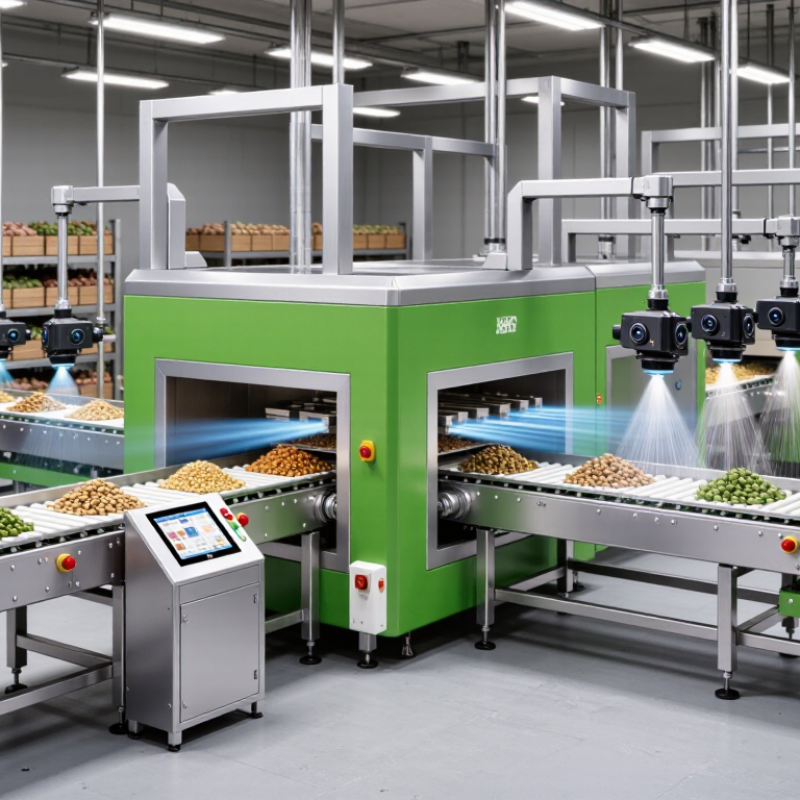
China has become an important source of advanced sorting equipment for food, recycling, and agricultural processing. Among these solutions, the Green Machine Optical Sorter combines camera imaging, intelligent software, and precise air-jet separation. It can identify differences in color, shape, size, and material composition. This technology helps processors improve product consistency while reducing manual inspection pressure.
A reliable supplier should offer more than a polished machine surface. Buyers need practical evidence, including sorting trials, technical drawings, production videos, and performance data from comparable materials. They should also examine sensor brands, lighting stability, nozzle response, belt design, cleaning access, and control-system usability. A professional China supplier normally provides installation guidance, operator training, spare-parts support, and responsive after-sales communication. Certifications and factory audits can strengthen confidence, but they should be checked independently.
Real performance depends on the material. Moisture, dust, mixed colors, belt speed, and contamination levels can change the final result. No sorter performs perfectly in every environment. That matters.
This introduction examines how to evaluate a Green Machine Optical Sorter supplier through engineering capability, manufacturing experience, quality control, and service reliability. It also considers customization, testing procedures, energy use, and long-term maintenance. Some suppliers may describe impressive removal rates without explaining test conditions. That gap deserves attention. A careful buyer should request sample testing before making a purchasing decision. The best choice is not always the cheapest or most automated model. It is the system that performs consistently, fits the production line, and remains supportable after installation.
What Is a Green Machine Optical Sorter?
A green machine optical sorter is an automated system for identifying and separating materials by color, shape, and spectral response. “Green machine” is not a universal technical classification. It usually describes sorting equipment designed to improve resource recovery and reduce waste. Cameras and near-infrared sensors scan a moving conveyor. Precise air jets then remove selected items into separate streams.
The process is quick. Often, it is imperfect.
A practical example is a mixed recycling line. The sorter can recognize clear plastic, colored plastic, paper, and unwanted materials at high belt speeds. Operators still need to adjust sensor sensitivity, belt loading, and air pressure. Poor lighting, dirt, overlapping objects, or damaged packaging can reduce accuracy. This is where real operating experience matters more than a brochure specification.
The Global E-waste Monitor 2024 reported 62 million tonnes of electronic waste generated worldwide in 2022, while only 22.3% was formally collected and recycled. The World Bank’s What a Waste 2.0 estimated 2.01 billion tonnes of municipal solid waste annually. These figures show why better separation equipment matters. A green machine optical sorter can support higher material purity, lower manual sorting exposure, and fewer recoverable resources sent to disposal. However, it cannot repair weak collection systems or replace trained inspection. Its environmental value depends on measured recovery rates, energy use, maintenance, and the final market for sorted materials.
China Best Green Machine Optical Sorter Supplier
How Green Machine Optical Sorters Identify Materials
Green machine optical sorters identify materials through cameras, light sources, and computer-controlled air jets. As items move along a conveyor, high-speed sensors examine their color, shape, brightness, and surface response. Near-infrared sensors can also recognize differences between paper, plastic, and other common materials. The system compares each item with programmed material patterns. When a target item is detected, a precise air pulse moves it into a separate chute.
Real sorting lines require careful setup. Operators adjust belt speed, lighting, sensor sensitivity, and air pressure for each material stream. A clear plastic bottle may look different when covered with dust or labels. Dark objects can also challenge some detection systems. No sorter is perfect. Experience shows that regular cleaning and calibration often improve accuracy more than aggressive software changes. Manual checks remain useful, especially when material loads change during the day.
Tips: Keep lenses clean, maintain steady conveyor loading, and record sorting results. Review rejected items regularly. Small adjustments can prevent repeated errors. Sensor settings may need revision after seasonal changes or equipment wear.
Optical sorting systems combine visible color, shape, and near-infrared spectral responses to distinguish materials. The chart shows typical density reference values for common recyclable materials.
Typical densities: PET ≈ 1.38 g/cm³, HDPE ≈ 0.95 g/cm³, PP ≈ 0.90 g/cm³, aluminum ≈ 2.70 g/cm³, and glass ≈ 2.50 g/cm³. Density supports material analysis but is not directly measured by optical sensors.
China Best Green Machine Optical Sorter Supplier
Key Technologies Used in Optical Sorting
Modern optical sorting begins with controlled lighting and high-speed imaging. RGB cameras identify visible color, shape, and surface defects. Near-infrared sensors read material differences that human eyes cannot detect. In some applications, hyperspectral imaging provides deeper chemical information. It can separate similar-looking materials more accurately.
The conveyor belt must remain stable. Even a small vibration can shift an object before detection. Software analyzes each item in milliseconds, then sends timing commands to precision air valves. Short air pulses remove selected materials into separate channels. The system needs careful calibration, because air pressure, belt speed, and nozzle distance affect final accuracy. Too much pressure wastes energy. Too little pressure leaves contamination behind.
Artificial intelligence improves recognition when materials overlap or appear dirty. Learning models can study verified samples and adjust to changing conditions. However, operators still need reliable reference samples and regular inspections. A machine may perform well during testing but struggle with dust, moisture, or unusual shapes. That weakness deserves attention. Practical suppliers should provide sensor calibration, diagnostic records, and accessible maintenance support. Clear data matters too. Performance should be checked through measurable rates, not attractive claims. Clean lenses, steady lighting, and timely software updates often influence results more than expected.
| Technology or System | Typical Operating Range or Specification | Primary Detection Capability | Common Material Applications | Contribution to Green Sorting | Practical Considerations |
|---|---|---|---|---|---|
| RGB Area Cameras | Visible light: approximately 400–700 nm | Identifies color, brightness, stains, surface discoloration, shape, and visible foreign matter. | Grains, pulses, seeds, nuts, dried foods, plastics, minerals, and recycled materials. | Enables precise rejection of defective items while retaining acceptable products and reducing material loss. | Performance depends on lighting uniformity, camera resolution, product spacing, and surface visibility. |
| Near-Infrared (NIR) Cameras | Commonly about 780–2,500 nm | Detects differences in chemical composition that may not be visible to the human eye, including moisture and material type. | Food ingredients, plastics, paper, textiles, wood, agricultural products, and mixed waste. | Improves material recovery and supports separation based on composition rather than appearance alone. | Detection can be affected by surface coatings, moisture, particle size, and overlapping materials. |
| Short-Wave Infrared (SWIR) | Approximately 1,000–2,500 nm | Provides stronger discrimination of moisture, organic materials, plastics, and certain surface or internal properties. | Recycled plastics, food products, minerals, agricultural commodities, and industrial raw materials. | Supports high-value recovery and reduces the amount of usable material sent to disposal. | Usually requires specialized sensors and controlled illumination; cost is generally higher than visible-light imaging. |
| Laser Scanning | Visible or near-infrared laser sources, depending on system design | Detects surface profile, texture, shape, cracks, foreign objects, and differences in reflectance. | Grains, fruits, vegetables, minerals, wood, recycled materials, and manufactured components. | Provides accurate defect detection and can operate effectively where color contrast is limited. | Laser safety, surface reflectivity, dust control, and correct optical alignment are important. |
| Hyperspectral Imaging | Multiple narrow spectral bands across visible and infrared wavelengths | Combines spatial and spectral information to distinguish materials with similar color but different composition. | Food quality inspection, agricultural products, recycling, pharmaceuticals, and mineral sorting. | Can increase sorting selectivity and reduce unnecessary rejection of acceptable material. | Generates larger data volumes and normally requires advanced processing, calibration, and application-specific models. |
| LED Illumination | Visible, infrared, or multispectral light sources | Creates stable, uniform lighting conditions for cameras and spectral sensors. | Used across food, grain, plastic, recycling, and mineral sorting systems. | LEDs typically provide long service life, low heat output, fast switching, and relatively low energy consumption. | Wavelength, intensity, diffuser design, and light angle must match the product and sensor configuration. |
| AI and Machine-Learning Vision | Application-specific models trained with labeled image or spectral data | Recognizes complex defects, irregular shapes, mixed materials, and patterns that are difficult to define with fixed thresholds. | Fresh and processed foods, recycling streams, grains, nuts, seeds, and industrial products. | Can improve classification consistency and adapt to more complex product variation. | Requires representative training data, model validation, stable image quality, and periodic performance monitoring. |
| Real-Time Image Processing | Millisecond-level processing synchronized with conveyor or chute movement | Converts sensor signals into product classifications and rejection commands while material is moving. | High-throughput food, agricultural, recycling, and mineral sorting lines. | Maintains continuous production and supports accurate decisions without manual inspection of every item. | Latency, data bandwidth, processing capacity, and synchronization accuracy directly affect sorting precision. |
| Compressed-Air Ejection | Short, controlled air pulses triggered by electronic valves | Physically removes detected defects or unwanted material from the product stream. | Grains, seeds, nuts, food products, plastics, glass, and lightweight recyclable materials. | Allows selective removal with no direct mechanical contact, reducing product damage and cross-contamination. | Air pressure, nozzle spacing, valve response time, and compressed-air cleanliness must be controlled. |
| Precision Nozzle and Valve Arrays | Individually controlled ejection zones along the sorting width | Targets specific particles based on their position, size, and movement trajectory. | Fine-grained food products, seeds, plastics, glass fragments, and small mineral particles. | Reduces unnecessary air consumption and limits the removal of nearby acceptable material. | Nozzle condition, spacing, response time, and product trajectory must be checked during maintenance. |
| Conveyor or Chute Feeding System | Configured according to material size, density, and required throughput | Presents material in a controlled field of view and helps maintain consistent spacing and speed. | Bulk agricultural products, food ingredients, plastics, minerals, and municipal or industrial recyclables. | Stable presentation improves recognition accuracy and reduces repeated processing or unnecessary rejection. | Feed rate, vibration, belt cleanliness, chute wear, and product overlap influence overall performance. |
| PLC and HMI Control | Real-time control of sensors, conveyors, valves, alarms, and operating recipes | Coordinates machine functions, records operating parameters, and allows operators to adjust sorting settings. | Applicable to nearly all automated optical sorting installations. | Improves process stability, enables recipe-based changeovers, and supports efficient troubleshooting. | Control logic, user permissions, communication protocols, and data logging should be configured for the application. |
| Automatic Calibration and Monitoring | Routine checks during startup and scheduled production intervals | Monitors illumination, sensor response, background conditions, air pressure, and sorting accuracy. | Continuous food, agricultural, recycling, and mineral processing operations. | Helps maintain consistent performance and reduces waste caused by undetected drift or incorrect settings. | Calibration targets, reference standards, cleaning procedures, and maintenance records should be standardized. |
| Dust and Optical-Surface Management | Air curtains, sealed enclosures, cleaning cycles, and filtered air systems | Preserves sensor visibility and reduces interference caused by dust, powder, moisture, or residue. | Grain, flour, minerals, recycling, wood, and other dusty or particulate materials. | Maintains stable detection performance and extends the useful operating life of optical components. | Cleaning frequency should reflect dust load, humidity, product characteristics, and production hours. |
Optical sorters are becoming practical tools across recycling and processing industries. In mixed plastic recycling, cameras and near-infrared sensors identify material by color, polymer type, and surface response. Air jets then separate target pieces from the main stream. This helps reduce manual sorting and improves the consistency of recovered materials.
The same technology supports glass, paper, packaging, grains, seeds, and mineral processing. In a glass line, it can remove ceramic fragments, stones, and colored contaminants. In food processing, careful calibration helps detect discolored grains or unwanted plant matter. Performance depends on lighting, belt speed, material moisture, and feed thickness. No sorter is perfect. Dust, overlapping items, and unusual colors can still cause missed decisions. Real operating data should guide adjustments, not assumptions.
Tips: Keep the material layer thin and even. Clean sensors regularly. Check rejection accuracy during every shift. Record false rejects and missed contaminants. A reliable supplier should explain detection limits, testing methods, maintenance needs, and expected throughput clearly. Request sample testing with your own material before purchase. That step often reveals practical issues that brochures miss. Teams should also train operators to review changing material conditions, because recycling streams rarely remain stable for long.
Selecting an optical sorter requires more than comparing machine prices. A reliable China-based supplier should explain sorting accuracy, capacity, power use, and material limits clearly. Ask for test results using your actual samples. A clean sample room helps, but it does not replace factory evidence. Request a video showing the feeder, cameras, air valves, and reject channel during continuous operation.
Check the supplier’s engineering depth. Confirm whether technicians can adjust lighting, belt speed, algorithms, and air pressure for changing materials. Ask how often calibration is needed. Review spare-parts availability, response times, installation support, and operator training. Written warranty terms matter. So do electrical diagrams, inspection records, and export documents. A supplier avoiding specific answers deserves caution.
Visit the production site when possible, or arrange an independent inspection. Look for labeled components, controlled assembly areas, and final testing records. Speak with recent customers, not only selected references. Small details matter. Ask who pays for damaged parts during transit and how remote diagnosis works. No supplier is flawless. I would question any company promising perfect accuracy in every condition. Dust, moisture, mixed sizes, and poor feeding can reduce performance. A pilot test may expose weaknesses before full purchase. Keep the criteria written, including recovery rate, contamination level, output quality, and acceptable loss.
If for some reason you did not find the service or product you need, you can always leave a request for a free consultation and get an answer.