
Choosing the right Microfluidic Chips requires more than comparing channel size or package price. Buyers must examine material compatibility, flow control, optical clarity, surface treatment, and manufacturing consistency. A glass chip may suit fluorescence imaging, while a polymer chip can support faster prototyping and lower-volume production. Small differences matter.
George M. Whitesides, a leading Harvard chemist and microfluidics researcher, described the field clearly: “Microfluidics is the science and technology of systems that process or manipulate small amounts of fluids, using channels with dimensions of tens to hundreds of micrometers.” His definition highlights the precision behind every chip, from a narrow inlet carrying a few microliters to a detection chamber smaller than a fingernail. Yet performance claims are not always comparable. Some are based on laboratory tests, not long-term commercial use.
This guide reviews ten Microfluidic Chips selected for global buyers. It considers research, diagnostics, environmental testing, food analysis, and industrial process development. Each option is assessed through practical factors, including channel design, bonding method, reagent compatibility, connection standards, customization, lead time, and technical support. Shipping conditions also deserve attention. Temperature swings, fragile ports, and unclear packaging can affect usability before testing begins.
Not every “best” chip fits every laboratory. That is the honest limitation. A budget-friendly cartridge may lack customization, while a premium chip may exceed a small project’s needs. The comparison therefore focuses on evidence, usable specifications, and realistic purchasing concerns. Readers can identify suitable candidates, question vague claims, and choose a platform that performs reliably beyond the catalog page.
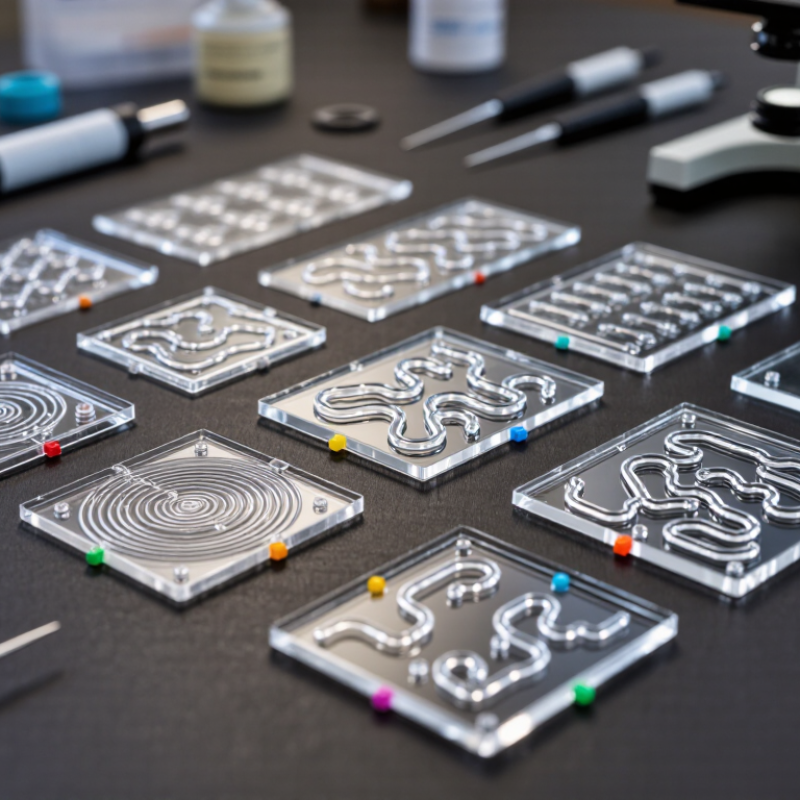
Microfluidic chips are compact devices that guide tiny liquid volumes through channels often narrower than a human hair. They can mix, separate, heat, or analyze samples with precise control. Small pumps, pressure differences, or electrical forces move the fluids. Because flow is usually smooth rather than turbulent, two liquids may travel side by side before slowly mixing. This feature supports fast reactions and uses far less sample than conventional laboratory equipment.
A typical chip contains channels, chambers, valves, and detection areas. Its material affects performance. Glass offers chemical stability, while polymers can reduce production costs and support disposable testing.
In practical evaluations, I would inspect channel dimensions, surface treatment, leakage resistance, and compatibility with the intended sample. A chip may look excellent on paper, yet perform poorly when bubbles enter the system. That weakness is easy to underestimate.
Global buyers should also check documentation, manufacturing tolerances, sterilization options, and transport conditions.
Tips: Select the chip around the sample, not only the application name. Confirm flow-rate ranges with real test data. Ask whether connectors and pumps are included. Check local requirements for laboratory use and waste handling. A small pilot test can reveal clogging, evaporation, or difficult loading before larger orders. Even experienced teams can miss one detail, especially when a design is highly customized.
Microfluidic chips vary by flow control, channel design, and biological purpose. Choosing the right type starts with the experiment, not the product label. Small volumes matter. Digital microfluidic chips move droplets through electrical control. They suit reagent mixing, sample preparation, and automated screening. Continuous-flow chips provide stable streams for chemical reactions, dilution studies, and particle separation.
Droplet chips create uniform reaction compartments inside oil phases. Researchers often use them for single-cell analysis, enzyme testing, and digital assays. Paper-based chips support low-cost diagnostics and field sampling, especially where laboratory infrastructure is limited. However, humidity can affect paper performance. That limitation deserves attention. Organ-on-chip platforms recreate controlled tissue environments with living cells, flow, and mechanical stimulation. They can support toxicity studies and disease-model research, but cell handling requires careful validation.
Gradient-generation chips produce changing concentrations across parallel channels. They help test drug responses, cell migration, and material behavior with fewer manual steps. Cell-culture chips usually include transparent areas for microscopy and ports for media exchange. In practice, port leakage and bubble formation remain common problems. I have seen promising designs fail because the tubing connection was overlooked. Buyers should verify channel materials, pressure tolerance, sterility options, optical clarity, and compatibility with existing pumps. A technically advanced chip may still be unsuitable if staff cannot operate it consistently.
How to Compare the 10 Best Microfluidic Chip Options
Comparing ten microfluidic chips requires more than checking price and channel count. Start with the application. A cell culture chip needs gentle flow, reliable gas exchange, and low-shear channel geometry. A diagnostic chip may need rapid mixing, clear optical paths, and simple sample loading. Define these requirements before reviewing supplier specifications.
Material selection matters. Glass offers strong chemical resistance and optical clarity, while polymers can reduce cost and support high-volume production. Check solvent compatibility, surface treatment, bonding quality, and storage conditions. Small defects can trap bubbles. They can also distort test results. Compare channel dimensions, flow-rate ranges, pressure limits, and connection types using the same units. Documentation quality is an important signal. Clear drawings and tolerance data support more reliable purchasing decisions.
Do not judge all ten options from laboratory performance alone. Compare lead times, minimum order quantities, customization limits, packaging, and technical support. Ask whether replacement chips match the original dimensions. Request sample units when possible. Test them with your actual fluid, tubing, pump, and imaging system. A chip that performs well with water may behave differently with protein-rich samples. Cost calculations can also mislead. I would include failed runs, setup time, and wasted reagents. Some comparisons remain imperfect because suppliers report data under different conditions. Record those gaps instead of hiding them.
This comparison uses representative operating flow-rate ranges commonly associated with each microfluidic chip architecture. Lower-flow formats are generally suitable for precise analytical and molecular workflows, while higher-flow formats are more appropriate for separation, mixing, and continuous processing. Actual performance depends on channel geometry, fluid viscosity, pressure limits, surface treatment, and assay requirements.
Choosing among ten microfluidic chips requires more than comparing channel images. Grand View Research estimated the global microfluidics market at approximately USD 28.3 billion in 2023. Its forecast also indicates strong growth through 2030. Buyers should therefore verify performance, documentation, and supply stability.
Measure channel dimensions, flow-rate limits, dead volume, burst pressure, and connection compatibility. Optical assays need clear, low-autofluorescence materials. Cell applications require controlled surface treatment and suitable biocompatibility evidence. ISO 10993 testing can support material evaluation, while ISO 13485 certification may indicate stronger manufacturing controls. Check sterilization methods, shelf life, packaging humidity, and temperature limits. Regional shipping can quietly change performance. A chip that works at 22°C may behave differently after air freight. One uncomfortable truth: no chip is perfect. Small variations between lots can affect pressure and assay timing.
Tips: Request at least three production lots. Ask for raw validation data, not only brochures. Confirm tolerances in writing. Compare the full delivered cost, including adapters, customs, storage, and rejected units. The 2024 MarketsandMarkets report projects continued double-digit expansion in microfluidics, but market growth does not guarantee consistent quality. Run a small pilot with real samples. Record bubbles, leakage, recovery rate, and operator handling time. Reflect carefully on failures; they may reveal a poor specification, not poor technique.
Purchasing, Customization, and Shipping Considerations Worldwide
Global buyers should evaluate more than channel design and unit price. Grand View Research estimated the microfluidics market at approximately USD 28.6 billion in 2023, with strong growth expected through 2030. This expansion increases supplier choices, but it also makes technical comparison harder. Ask for dimensional tolerances, material certificates, bonding methods, surface treatments, and leakage-test records. A low unit price can mislead. Compatibility with reagents, imaging systems, and laboratory automation often determines the real cost.
Customization should begin with the assay, not a supplier’s standard catalog. Define channel width, inlet geometry, optical requirements, pressure limits, and required volume. For biological applications, request extractables information and documented biocompatibility evidence. MarketsandMarkets projects rapid growth in microfluidic component demand, partly driven by diagnostics and research automation. That trend supports custom production, but small design changes can extend tooling schedules. Recheck drawings before approval. Small errors matter.
Shipping requires equal discipline. Protect chips from dust, vibration, moisture, and temperature swings. Use rigid trays, sealed pouches, and lot-level labeling. Confirm the correct tariff classification, commercial invoice details, country-of-origin statement, and Incoterms before dispatch. Transit time is not the same as delivery reliability. A logistics plan should include customs clearance, inspection delays, and replacement procedures. International buyers should also request pre-shipment photos and a sample inspection report. Some purchasing teams overlook this practical step. They regret it later.
If for some reason you did not find the service or product you need, you can always leave a request for a free consultation and get an answer.