In 2026, global buyers face more cargo container choices than ever before. Choosing well requires more than comparing prices online. A standard dry container suits general goods, while refrigerated models protect temperature-sensitive products. Open-top and flat-rack designs support tall, wide, or heavy equipment. Small differences in construction can affect loading, handling, and long-term costs. Good decisions need evidence.
This guide examines the best cargo container types for international purchasing and supply planning. It compares practical uses, dimensions, materials, door designs, ventilation, and weather resistance. Temperature control receives close attention because one failed cooling unit can damage an entire shipment. Buyers should also review container condition, certification records, inspection photos, and supplier history. Details matter.
Experience shows that the lowest purchase price may not produce the lowest total cost. Delivery distance, port handling, maintenance access, and regional availability can change the final result. Some buyers may prefer new containers, while others may accept inspected used units for suitable applications. That choice deserves careful reflection. The market changes quickly, and supplier claims are not always equally reliable. No single type fits every business. Buyers should match container design with cargo dimensions, handling equipment, route conditions, and storage needs. Independent inspection can reduce uncertainty before payment. The best option is usually the safest practical fit, not the most impressive specification. Even strong recommendations need review against current project requirements.
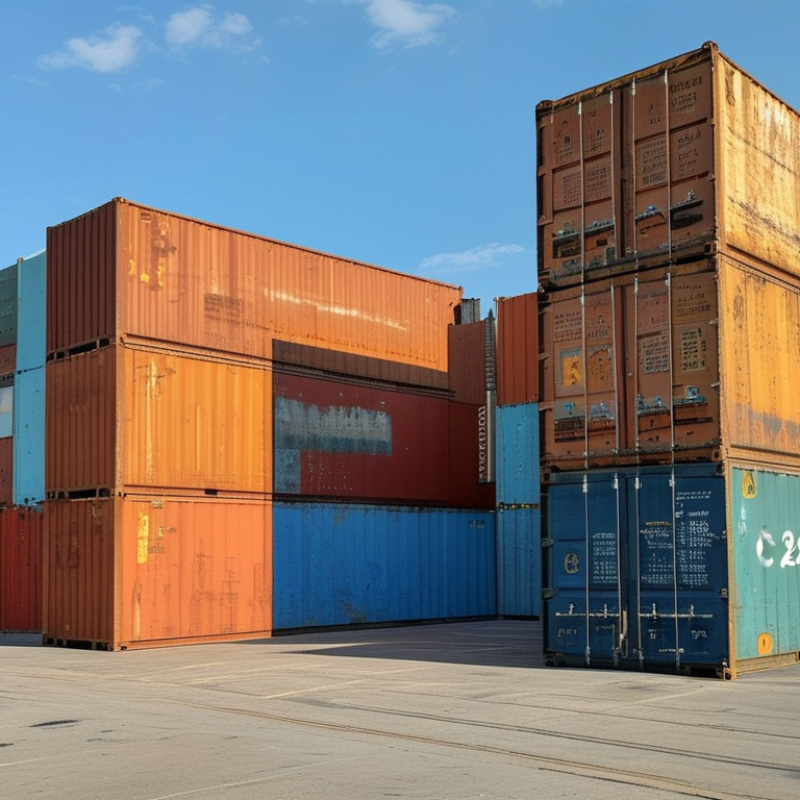
ISO 668 classifies the main dry cargo container sizes used in international logistics. A 20-foot container measures about 6.058 metres long, 2.438 metres wide, and 2.591 metres high externally. It equals one TEU and suits dense cargo, machinery, boxed goods, and palletized materials. A 40-foot container keeps the same width and height but extends to about 12.192 metres. It provides nearly twice the floor length, although payload limits still depend on the safety plate, axle rules, and cargo distribution. Bigger does not always mean better.
UNCTAD’s Review of Maritime Transport 2024 recorded global maritime trade at approximately 12.3 billion tonnes in 2023.
Containerized cargo remains central to that flow, making accurate size selection commercially important. A 40-foot high-cube unit follows the 40-foot footprint under ISO 668 but reaches about 2.896 metres high. That adds roughly 30 centimetres of internal clearance. It helps with tall cartons, lightweight furniture, insulation materials, and extra packaging. Buyers should verify door height, usable internal length, and cubic capacity with the supplier. Published dimensions are nominal. Actual interiors can vary slightly. The same report expected maritime trade growth to continue, but forecasts can miss disruptions, port congestion, and equipment shortages. That uncertainty deserves attention when choosing between 20-foot, 40-foot, and high-cube units.
A 20-foot cargo container remains a practical choice for global buyers handling dense, compact freight. Its maximum gross weight can reach 30,480 kg, including the container itself. The usable cargo weight is lower because an empty unit often weighs about 2,200–2,400 kg. Weight comes first. A shipment near the limit needs accurate cargo and packaging records. Guessing can create costly delays.
The internal floor usually measures about 5.9 meters long and 2.35 meters wide. This space suits machinery parts, boxed materials, metal products, and palletized goods. Load heavy items low and near the center. Keep weight distributed across the floor. Uneven loading can affect handling, lifting, and container safety. Wooden blocks, straps, and edge protection should prevent movement without damaging the cargo.
The 30,480 kg figure is not a universal operating allowance. The container’s safety plate, vessel operator, port equipment, road rules, and rail limits may impose lower figures. Check each requirement before booking transport. A detailed packing list should show item weight, dimensions, quantity, and loading position. Small errors matter. A clean spreadsheet can still miss moisture, pallets, or protective materials. Recheck the final gross weight after loading, then photograph the sealed interior and identification markings for reliable records.
Match Cargo to Capacity: 20-Foot Units Carry Up to 30,480 kg Gross
Standard 20-foot dry containers typically provide about 33.2 m³ of internal volume, while 40-foot high-cube units provide about 76.4 m³. A 30,480 kg maximum gross mass is a common rating for standard ISO container equipment, but the permitted cargo payload depends on the container tare weight, road regulations, vessel limits, and the actual unit specification. Refrigerated-container capacity is lower because of insulation and cooling equipment.
For global buyers, the key choice often comes down to dry vans and high cubes. A standard dry van stands about 8 ft 6 in high externally. A high cube reaches roughly 9 ft 6 in, adding about one foot of vertical space. Internal measurements vary by construction, flooring, and door design, so published dimensions need verification.
That extra clearance matters when loading tall cartons, furniture, machinery, or stacked retail displays. In practice, a high cube can reduce wasted space above the cargo. It may also allow safer stacking without pressing boxes against the roof. However, height is not always the deciding factor. Cargo weight, loading equipment, route limits, and warehouse doors can change the better choice.
I check the cargo height, pallet pattern, and door opening before comparing prices. A one-inch mistake can disrupt an entire loading plan. Measure the tallest packed unit, not the product alone. Allow room for wrapping and uneven floors. I also review inspection records, roof condition, door seals, corner posts, and floor strength. High cubes often cost more, yet unused headroom creates poor value. Sometimes, the standard 8 ft 6 in container is the more reliable fit. That judgment deserves a second check.
| Comparison Dimension | Standard Dry Van 8 ft 6 in Height |
High Cube 9 ft 6 in Height |
Buyer Consideration |
|---|---|---|---|
| Common Lengths | 20 ft and 40 ft; 45 ft versions are also available in some trade lanes. | Most commonly 40 ft and 45 ft; 20 ft high-cube units exist but are less common. | Choose the length that matches the cargo volume, inland route, and port availability. |
| External Width | Approximately 8 ft (2.44 m). | Approximately 8 ft (2.44 m). | Both types use the standard container width for ocean transport and intermodal handling. |
| External Height | 8 ft 6 in (2.59 m). | 9 ft 6 in (2.90 m). | A high cube provides an additional 1 ft (30 cm) of external height. |
| Typical Internal Height | About 7 ft 8 in (2.35 m), depending on construction and floor design. | About 8 ft 9 in (2.69 m), depending on construction and floor design. | Confirm the actual internal height before loading tall machinery, pallets, or cartons. |
| Typical Internal Width | About 7 ft 8 in (2.35 m). | About 7 ft 8 in (2.35 m). | Internal width is broadly similar; the main dimensional advantage is vertical space. |
| Typical Internal Length | 20 ft: about 19 ft 4 in (5.90 m). 40 ft: about 39 ft 5 in (12.03 m). |
40 ft: about 39 ft 5 in (12.03 m). 45 ft: about 44 ft 6 in (13.56 m). |
Usable length varies by container series, door design, and manufacturer tolerances. |
| Approximate Internal Volume | 20 ft: about 33 m³. 40 ft: about 67 m³. |
40 ft: about 76 m³. 45 ft: about 86 m³. |
High cubes generally add approximately 9 m³ in a 40 ft format, mainly through extra height. |
| Approximate Empty Weight | 20 ft: roughly 2.2–2.4 tonnes. 40 ft: roughly 3.7–4.0 tonnes. |
40 ft: roughly 3.9–4.2 tonnes. 45 ft: commonly above 4.5 tonnes. |
Actual tare weight is printed on the container plate and may differ by design and equipment age. |
| Maximum Gross Mass | Often rated at up to 30.48 tonnes, subject to the container safety plate and local regulations. | Often rated at up to 30.48 tonnes, subject to the container safety plate and local regulations. | Do not calculate payload from volume alone; use the certified maximum gross mass. |
| Approximate Payload Potential | Commonly about 26–28 tonnes, depending on tare weight and legal road limits. | Commonly about 26–28 tonnes, depending on tare weight and legal road limits. | Road axle limits may restrict the practical payload below the container's rated capacity. |
| Pallet Loading | A 40 ft unit commonly accommodates around 20 standard 1,200 × 1,000 mm pallets in a single-layer layout, subject to loading pattern. | A 40 ft unit generally has a similar pallet footprint to a standard-height 40 ft unit, but offers more vertical clearance. | High cubes are most valuable when cargo is lightweight, bulky, or stackable. |
| Best Cargo Profile | General cargo, boxed goods, machinery, furniture, packaged materials, and standard palletized freight. | Voluminous or tall cargo, lightweight manufactured goods, furniture, textiles, packaging, and high-stack pallet loads. | Select based on cubic volume, height, weight, and loading method rather than container name alone. |
| Door Opening Height | Typically about 7 ft 5 in to 7 ft 6 in (2.26–2.28 m). | Typically about 8 ft 5 in to 8 ft 6 in (2.57–2.59 m). | Check door clearance when cargo is pre-assembled or loaded with forklifts. |
| Main Advantage | Widely available, broadly accepted, and usually suitable for standard cargo dimensions. | Greater cubic capacity and approximately 30 cm of additional vertical clearance. | High cubes can reduce the number of containers needed for lightweight, space-consuming cargo. |
| Main Limitation | Less vertical space for tall or high-volume cargo. | May face height restrictions on certain inland roads, depots, tunnels, rail routes, or storage sites. | Confirm the full door-to-door route before finalizing the equipment type. |
| Recommended Choice | Use when cargo is dense, standard-height, readily available, or subject to inland height restrictions. | Use when cargo is bulky, lightweight, tall, or close to the volume limit of a standard dry van. | Always verify dimensions, tare weight, CSC plate details, booking availability, and local transport limits. |
| Important: Dimensions and weights are typical industry ranges for planning purposes. Exact specifications vary by container series, owner, age, floor construction, door configuration, and applicable transport regulations. The certified container plate and carrier documentation should control the final purchase or shipment decision. | |||
2026 Best Cargo Container Types for Global Buyers
Reefers and tank containers serve different cargo needs, yet both require careful specification. Reefers can maintain temperatures from about −30°C to +30°C, supporting frozen foods, fresh produce, pharmaceuticals, and temperature-sensitive materials. Confirm the actual operating range before booking. Some units may display a broad range but perform poorly at extreme settings.
A reefer inspection should cover the door gasket, floor channels, air circulation, and temperature recorder. Place pallets with clear space near the evaporator outlet. Do not block airflow with tight wrapping. A small loading mistake can create warm corners, even when the display shows the correct temperature. Pre-cooling the container also matters. Loading warm cargo into a cold box wastes energy and increases temperature recovery time.
Tank containers commonly provide 20–26 m³ of usable volume, depending on design and required safety space. They suit approved liquid products that need controlled filling, secure valves, and reliable pressure protection. Check the tank’s inspection date, material compatibility, insulation, and cleaning records. Product density changes the payload, so cubic capacity alone cannot determine the correct model. This is an easy point to overlook.
Practical buyers should compare the cargo’s temperature, viscosity, density, and loading method before selecting either container. A specification sheet may look complete, but real loading conditions can expose gaps. Temperature mapping, documented inspections, and verified handling procedures provide stronger evidence than appearance alone.
In 2026, container selection should begin with compliance, not paint, price, or advertised capacity. A dry van may suit general cargo, while refrigerated, open-top, and flat-rack units serve specific loading needs. Every container intended for international sea transport should carry a readable CSC Safety Approval Plate. This plate connects the unit with the 1972 International Convention for Safe Containers. Check its approval number, manufacture date, maximum gross mass, stacking limit, and racking test value. Do not rely on a seller’s photograph alone.
Request recent inspection evidence. Look for legible welds, straight corner posts, sound locking bars, and doors that seal evenly. A valid plate does not prove the container is damage-free today. A common field mistake is checking the plate while missing a bent bottom rail. That oversight can delay loading or trigger another inspection. Inspection intervals depend on the approved examination scheme and local requirements. Confirm the current status with a qualified inspector or competent authority. Dates matter.
UN ratings require separate attention. They are not general quality labels for every cargo container. For regulated cargo, a UN specification may apply to the packaging or tank inside the container. Verify the complete marking, test level, capacity, closure condition, and cargo documentation. Never assume a CSC plate replaces UN approval. Requirements can differ by sea, road, rail, and destination country. Keep inspection reports, plate photographs, repair records, and loading limits together. Records are boring. Missing evidence can become expensive. One extra review may be wiser than a quick purchase.
If for some reason you did not find the service or product you need, you can always leave a request for a free consultation and get an answer.